Global paid leave report
Which countries get the most paid time off in 2025?
Between annual leave and public holidays, the amount of statutory paid leave offered varies considerably around the world. We found out how many days employees can take in every country, including both the good and bad news about paid leave in the UK.

Contents
-
Chapter 1
Introduction
-
Chapter 2
The countries with the most and least paid leave overall
-
Chapter 3
The countries with the most and least paid annual leave
-
Chapter 4
The countries with the most and least paid public holidays
-
Chapter 5
The countries where paid leave is worth the most, financially
-
Chapter 6
Frequently asked questions
Key findings
-
46
paid days off in Yemen
The number of paid days off available to employees in Yemen, the country that offers the most statutory paid leave. -
0
paid days off in the U.S.
The number of statutory paid days off available to employees in the U.S., the only country that offers zero statutory paid leave or public holidays. -
2960
leave allowance per employee
Or $4,040 is the value of the UK’s annual leave allowance for someone on the average salary; the 19th highest in the world.

Chapter 1
Introduction
In this chapter you’ll learn
- How paid time off has evolved in the UK.
- How cultural differences have shaped worker rights around the world.
- How we surveyed the state of paid time off internationally.
The amount of paid time off that national governments guarantee to employees is a matter of culture wrapped up in legislation.
How paid time off has evolved in the UK
The UK government first granted one week of paid leave to some workers in 1938; as late as 1993, John Major’s government opted out of EU legislation giving Europeans four weeks of annual paid leave. When Labour finally implemented this directive in 1998, six million workers got more paid leave than ever before, while two million got it for the first time. The UK still lags behind much of Europe in other types of time off, such as paternity leave.
How cultural differences have shaped worker rights around the world
In Spain, legislation from 2023 allows for paid menstrual leave for those with period pain, but there has not been a large uptake, partly because women are concerned they will be treated differently for claiming their new rights. In the U.S., there is no statutory paid vacation, and 46% of workers whose employers offer time off use it only partially. This may be due to the American emphasis on productivity: some 49% worry about falling behind if they took more time off, and 43% say they’d feel bad about their co-workers taking on their workload.
And in Sweden, pioneering reforms in parental leave have been so effective that it is now taboo for dads not to take time off with their newborn. Swedish companies have benefitted from using these rights to attract the best in international talent.
How we surveyed the state of paid time off internationally
So when it comes to basic paid leave – statutory holiday pay and paid public holidays – every country follows its own pattern. To find out how this key workers’ right differs internationally, Moorepay identified the countries where people get the most paid time off by sourcing the statutory paid leave and paid public holidays from each country’s governmental websites. We also used the adjusted net income per capita in USD from worldbank.org for each country to calculate how much their total paid time off is worth on average.

Chapter 2
The countries with the most and least paid leave overall
In this chapter you’ll learn
- What keeps the UK from being one of the best countries for paid time off.
- Which countries offer the most combined annual leave and public holidays.
- Why the U.S. offers zero statutory paid days off.
First, we looked at the total time off (statutory paid annual leave plus paid public holidays) in every country. While UK employers are now obliged to grant 28 days of paid annual leave, the fact that employees are not entitled to paid bank holidays means the country comes up short: there are 113 countries that offer more paid leave in total than the UK.
The country that fares the best is Yemen, where workers have the right to 30 days of annual leave and 16 public holidays, giving a total of 46 days, or six and a half weeks.
In Europe, Austria leads the way with 43 paid days off in total, comprising 30 days of annual leave and 13 public holidays. However, when you start a new job, for the first six months, you can only claim leave proportionate to the time worked. After that, you become eligible for full leave. Public holidays are mostly centred on the Christian calendar, although Austria celebrates its National Day on October 26.
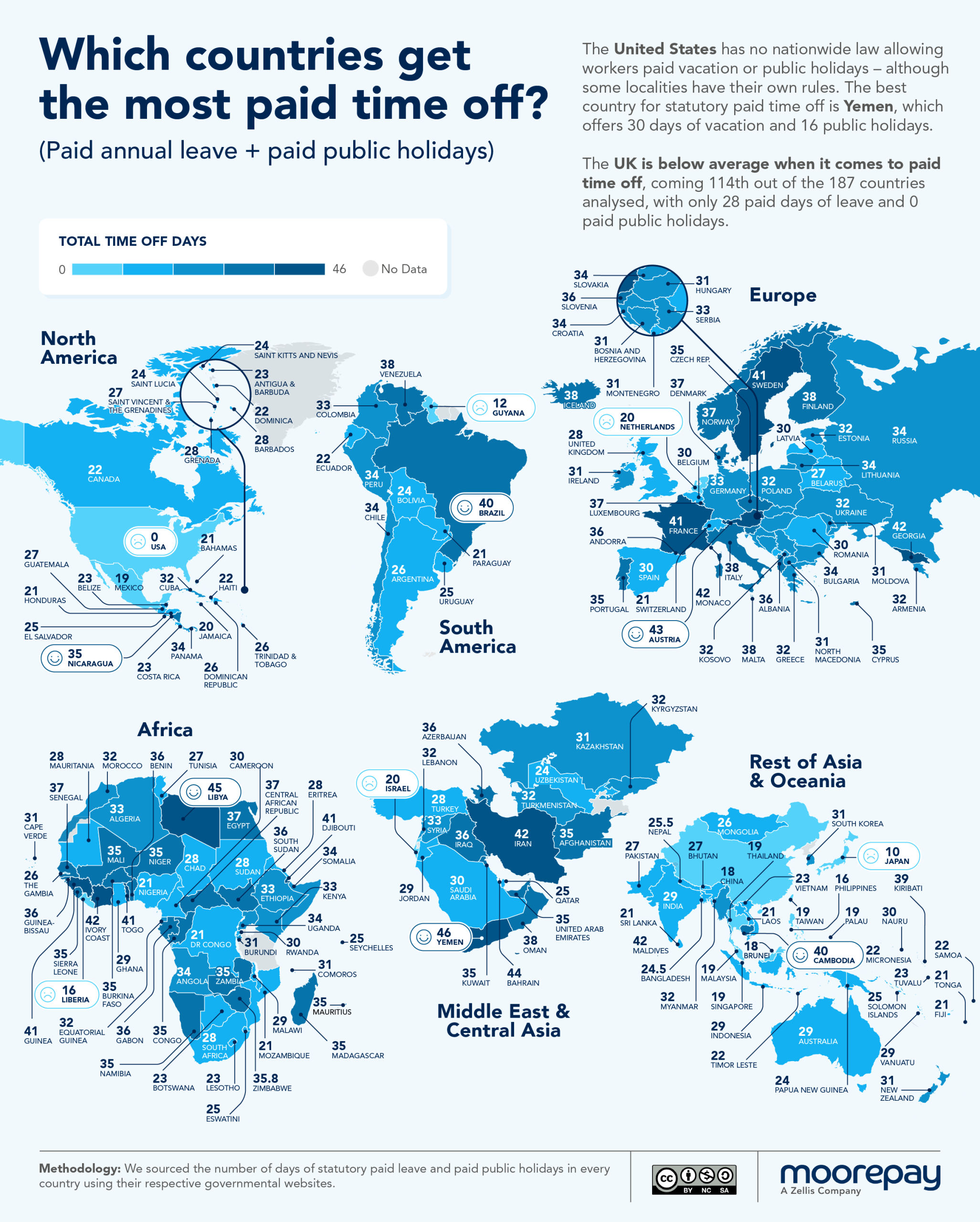
You will notice that the U.S. props up all three of the tables in our report. Despite the positive social and economic impact of other improvements in worker rights, “America is the only high-income country that does not guarantee workers paid time off as part of national workplace standards,” notes Betsey Stevenson, a Professor of Public Policy and Economics. “These benefits are generally a matter of agreement between an employer and an employee,” advises the Department of Labor.
Donald Trump announced two new public holidays in May 2025 – but like all the others, these will not be statutory paid days off. “We will not be closing the Country for these two very important holidays,” posted Trump, “because we already have too many holidays in America – there are not enough days left in the year. We were workers then, and we are workers now!”
Read more about holiday entitlement and pay
-

Holiday entitlement calculator – calculations made easy
Calculating holiday entitlement for full-time employees is relatively straightforward. But what about when an employee starts or leaves partway through the holiday year, and what about part-time employees?
-

Holiday entitlement for different employment types
Giving the correct holiday entitlement for different types of workers can be very confusing. And the legislation behind them can be more confusing still! But it’s important to get to grips with how you make these calculations so you pay your employees fairly for the holiday they’re owed.

Chapter 3
The countries with the most and least paid annual leave
In this chapter you’ll learn
- How the UK first gained paid holiday time.
- Which countries have the most paid time off outside of public holidays.
- Why Canada lags behind Europe on statutory paid leave.
In our study we narrowed down our research to focus on paid annual leave (vacation) alone.
By this metric, the UK makes it into the top ten (in tenth place) due to the four weeks (28 days) of paid leave. “Too much mischief has been done in the past by treating workpeople simply as production units instead of human beings,” said Lord Amulree, as he guided a parliamentary select committee towards recommending what would be the Holidays with Pay Act – the first legislation guaranteeing many UK workers paid leave in 1938.
As one factory worker reported, shortly after the Act passed: “We have had a good holiday, feeling for the first time that we could afford to pay for it without having to apologise to the butcher and baker for being unable to meet his bills the week after. I feel I am justified in saying ‘thank you’ to whoever it was who did the trick.”
However, while working families welcomed the time off, not many managed to get away as they were still not earning enough for a resort holiday.
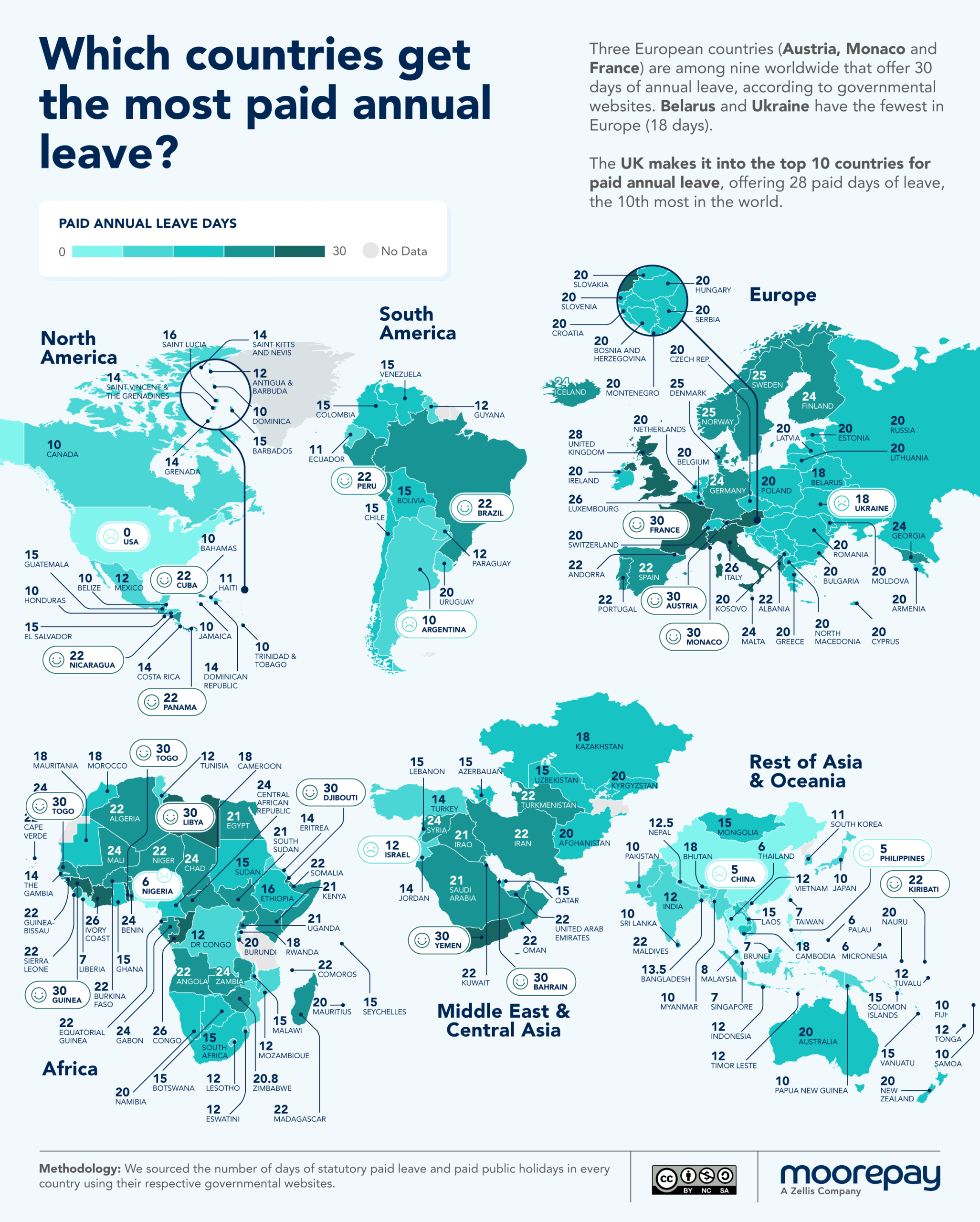
Along with the U.S., which has no statutory paid leave (see above), Canada is one of the anglophone countries with the fewest days of paid vacation: just ten. One reason for this – or two, depending on how you look at it – is Canada’s proximity to the U.S.
Canadian businesses often compete more or less directly with those of the U.S. So, whether by design or indoctrination or both, Canada’s work culture can be quite similar to America’s.
On the bright side, Canada at least equals the global average number of paid public holidays (12), with Victoria Day or National Patriots Day, Canada Day, Labour Day, the National Day for Truth and Reconciliation and one provincial holiday in addition to the common Western holidays. Separately, the campaign for a four-day workweek – with no impact on productivity -remains on the table.

Chapter 4
The countries with the most and least paid public holidays
In this chapter you’ll learn
- How public holidays are treated by UK employment law.
- The countries that offer no paid public holidays.
- The cultural background to the many public holidays in Georgia, Venezuela and much of Asia.
“Bank or public holidays do not have to be given as paid leave,” according to the UK government. “An employer can choose to include bank holidays as part of a worker’s statutory annual leave.”
The Citizens’ Advice Bureau states it more bluntly for employees: your employer decides if you work bank holidays or not, and they can make you take them as part of your 28 days of statutory holiday if they choose.
This puts the UK among five countries globally that offer zero paid public holidays. The others are the Netherlands, the U.S., Japan and Guyana. However, it is common in the UK for employers to choose to give public holidays off with pay from their own payroll or to offer an extra day of paid leave for those who work on a bank holiday.
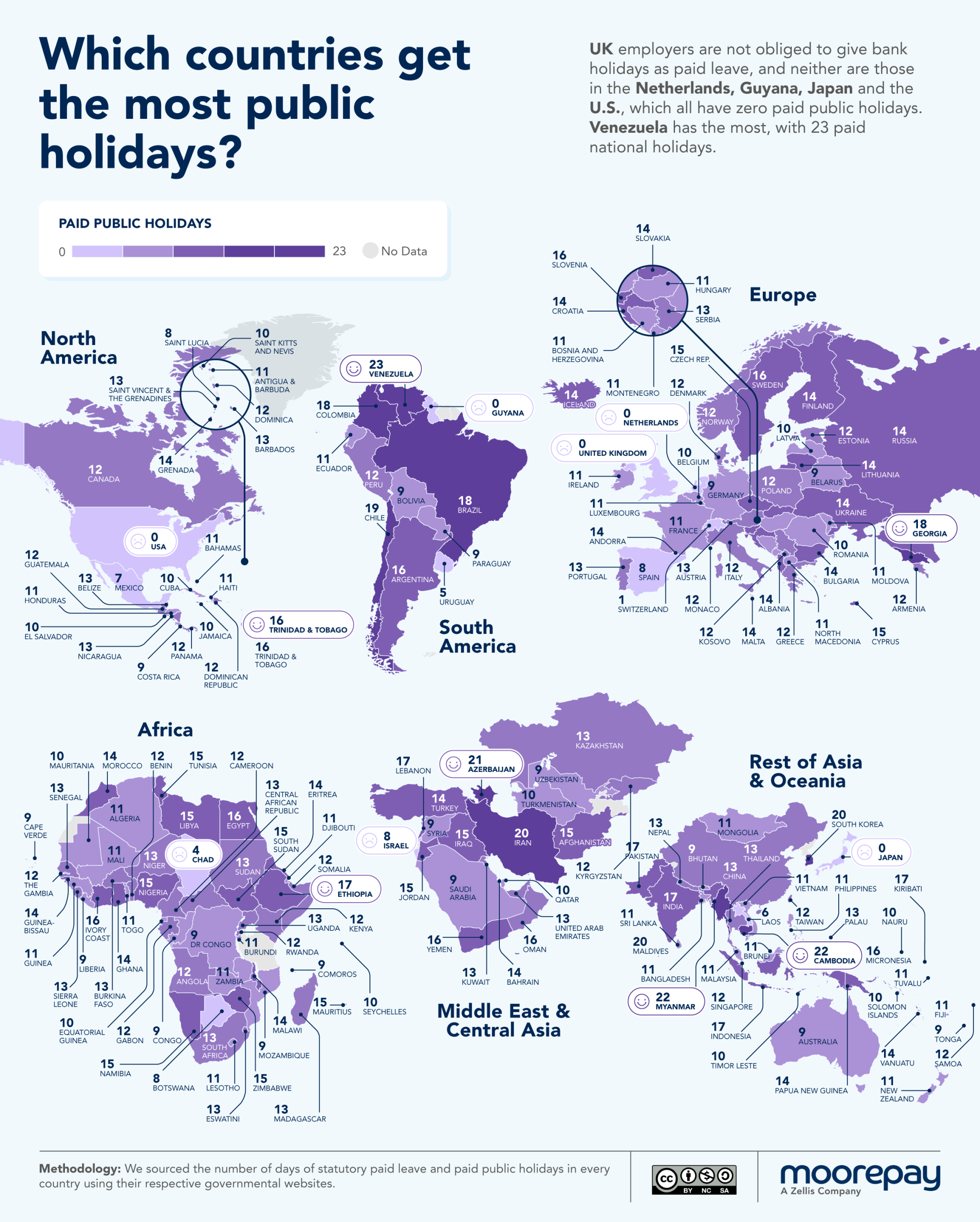
The European country with the most paid public holidays is Georgia, with 18. These include a number of religious days, as well as Victory over Fascism Day (in honour of World War 2), Georgian Mother’s Day and International Women’s Day. Since Georgia also offers 24 days of paid annual leave, this former Soviet Republic is one of the most thoughtful in the world towards its workers. Most can also claim up to 15 days of unpaid leave each year, too.
However, the countries with the most paid public holidays are mostly in Asia and the Middle East. Cambodia, Myanmar and Azerbaijan are among those with more than 20 public holidays. Several Asian countries recognise multiple Buddhist observances or have several different faiths that are well-represented among their population. In Cambodia, in particular, there are numerous holidays in honour of each of the country’s turbulent past, its royal family and local cultural traditions.
But Venezuela in South America has the most: 23 paid public holidays, including Catholic observances and separate tributes to Spain, Catalonia, Venezuelan independence and indigenous resistance. President Nicolás Maduro hit the headlines in 2024 when he tried to boost morale by moving Christmas to October.

Chapter 5
The countries where paid leave is worth the most, financially
In this chapter you’ll learn
- Which country’s workers can earn the most for staying home on statutory leave.
- How much UK employees earn from time off if they take all their annual holiday allowance.
- How to explore our paid leave data in full.
Finally, we used the average income in each country (according to the World Bank), converted into U.S. dollars, to calculate how much the average employee ‘earns’ on their statutory paid leave and public holidays each year.
Luxembourg may not offer the most days off – 23 countries offer more – but with 26 days of annual leave and 11 public holidays on a daily wage of US$311.12 (£232.22), the average employee in Luxembourg can take home $11,511.61 (£8,434) based just on statutory leave. In Norway, which has the same number of paid days leave as Luxembourg, the average employee can earn $10,353 (£7,585) while taking those days off.
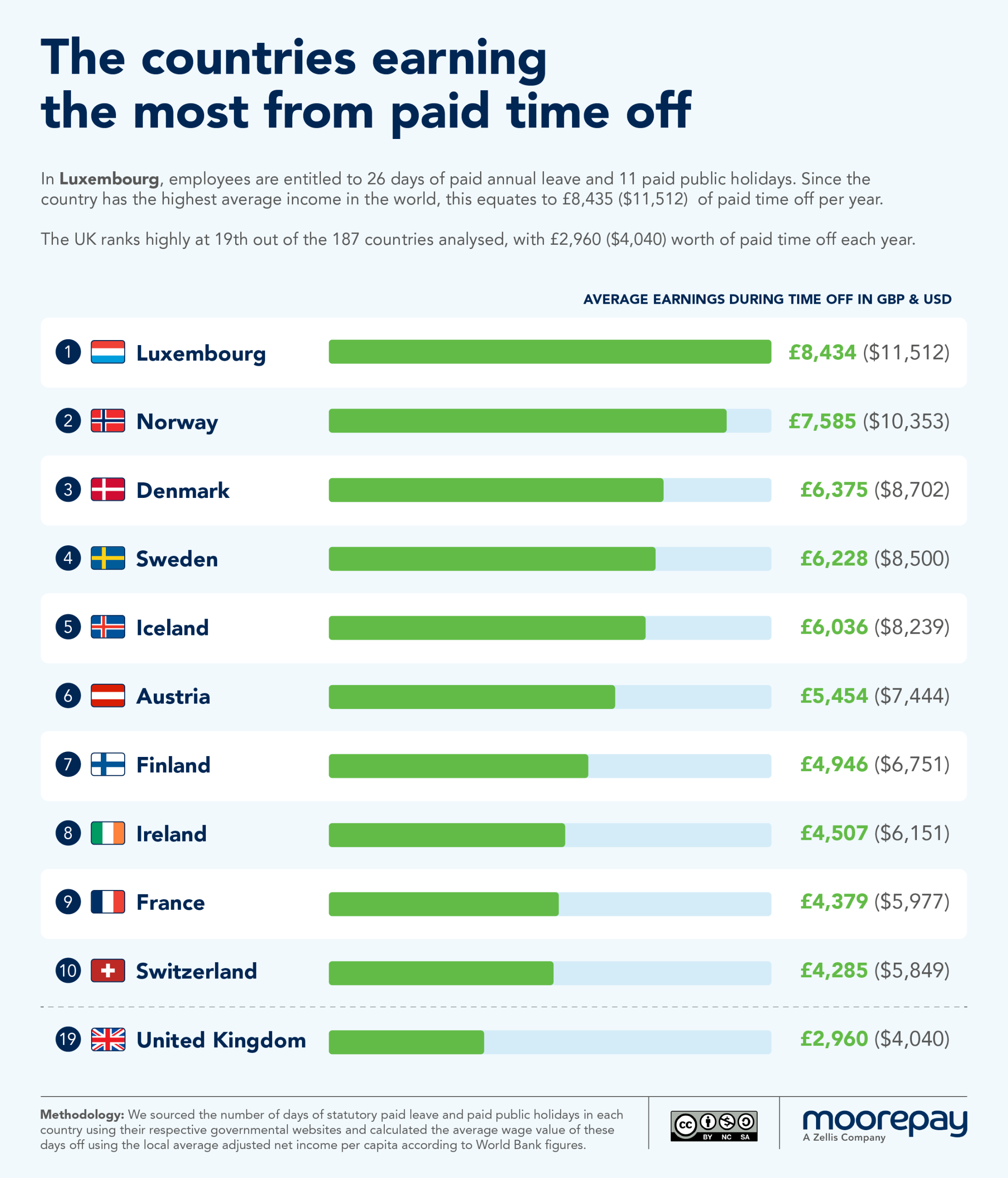
Indeed, a combination of moderately to very generous paid leave policies and high wages means that all of the top ten countries for earnings during time off are in Europe, and five of them are Nordic countries.
You can explore and sort the data by different categories of days off and what they are worth in average local earnings using this interactive table.
As for the UK, 28 days off, paid at the average daily rate of US$144.29 (£107.70), gives an income of $4,040.14 (£2,960). This is the nineteenth-highest figure in the world and sandwiches the UK between Kuwait ($4,071.22 / £2,982) and Singapore ($3,852.44 / £2,823).
PAST WEBINAR
Effective absence management
While every business will experience absence, the way every business handles it will be very different. Accurately tracking it, applying legislation, and reporting on it can be difficult and, not to mention, time-consuming.
Mishandling absence in your business can leave you open to risk, impact employee experience and could see your business losing money. That’s why we created this webinar with our in-house experts, to help you manage absence strategically.

Chapter 6
Frequently asked questions
In this chapter you’ll learn
- A summary of key statistics from our findings.
- Study methodology and sources.
FAQs
Yemen offers the most statutory paid time off: 46 days, comprising 30 days of annual leave and 16 public holidays.
The U.S. offers the least paid time off. It is the only country in our study that offers both zero statutory paid leave and zero paid public holidays.
There are nine countries that offer 30 days of statutory paid leave: Libya, Djibouti, Guinea, Togo, Austria, Monaco, France, Yemen and Bahrain.
The U.S. doesn’t offer any paid annual leave. Of those countries that do, China and the Philippines offer the least: five days each.
Venezuela offers 23 statutory paid public holidays off work.
There are five countries that don’t offer statutory pay for public holidays: the UK, the Netherlands, the U.S., Japan and Guyana.
In the UK, you are entitled to 28 days of statutory paid annual leave. There is no statutory entitlement to be paid for taking a bank holiday off work, and it is at the employer’s discretion whether they give you the time off, in which case they can subtract it from your paid annual leave. However, many UK employers offer a day off in lieu if you work on a bank holiday or will pay you for the bank holiday if you take it off.
Methodology and sources
We determined the countries that receive the most paid time off by adding the statutory paid leave and statutory paid public holidays together for each nation. These figures were sourced from governmental websites.
To create a fair comparison, all statutory leave was converted into working days for the select countries where leave is reported in “calendar days,” assuming a five-day workweek.
Finally, we retrieved the adjusted net income per capita in USD from worldbank.org for each country and calculated how much each country’s total paid time off is worth on average.
The data is accurate as of June 2025.
Contents
Jump back to the chapter you want to re-read.
-
Chapter 1
Introduction
-
Chapter 2
The countries with the most and least paid leave overall
-
Chapter 3
The countries with the most and least paid annual leave
-
Chapter 4
The countries with the most and least paid public holidays
-
Chapter 5
The countries where paid leave is worth the most, financially
-
Chapter 6
Frequently asked questions