Global sick leave report
Which countries offer the best sick pay in 2025?
UK sick pay rules are set to be updated in 2026 – but the figure claimable will remain among the lowest globally. Here’s how the UK measures up against the countries that pay the best and worst rates of sick pay, both in absolute terms and when allowing for local purchasing power.

Contents
Key findings
-
47.50
UK
The amount of statutory sick pay for workers during the first week of leave. -
1107.29
Luxembourg
The first week’s sick pay that can be claimed by a worker on average pay. -
0.00
South Korea, US and Tunisia
The statutory sick pay that workers can claim. -
4.4
Average sick days
taken annually by employees in the UK.

Chapter 1
Introduction
In this chapter you’ll learn
- How sick pay works in the UK.
- How sick pay in the UK compares to the rest of the world.
- How Moorepay identified the best and worst sick pay arrangements around the world.
The importance of sick pay
Sick pay is an essential part of the socio-economic contract and contributes to public health improvements and individual well-being. It also potentially boosts employment rates and employee engagement.
A decent sick leave policy can also reduce the cost of “presenteeism” – the lower productivity of employees who work on through illness or injury instead of taking time off to recover. The annual cost of presenteeism to UK businesses has risen by $25 billion over the last half-decade, according to the Institute for Public Policy Research (IPPR). Many can’t afford to take time off on heavily reduced pay, and economic pressure to work through illness or injury increases the risk of illness spreading through the workplace, among other health and safety issues.
The UK’s current sick pay system
The UK government requires employers to pay £118.75 per week of Statutory Sick Pay (SSP) for up to 28 weeks if an employee cannot work due to illness. Employees do not receive SSP for the first three days of illness unless they’ve received SSP within the previous eight weeks (for our calculations, we have assumed our hypothetical worker has not received SSP lately). This is likely to change in April 2026, with new rules entitling workers to SSP from the first day of illness and the removal of the lower earnings threshold.
The UK’s 4.4 million self-employed workers are not eligible for SSP but may be able to access money through the government’s Employment and Support Allowance (ESA).
How the UK compares globally
Given that the first three days of sick leave go unpaid, Brits are entitled to just £47.50 for their first week of sick leave. This positions UK rates between those of Indonesia (£45.40) and Sri Lanka (£51.41) and below every European country except for Armenia (£43.17). When calculated in international dollars – a hypothetical currency that allows for local purchasing power – the UK ranks 95th in the world (Intl$69.92).
To compare UK sick pay rates to those around the world, Moorepay has calculated the amount of sick pay a resident would receive for the first week of sick leave, taking into account the national adjusted net income per capita for each country (from the World Bank). Then, we converted these figures into U.S. Dollars, GBP and international dollars, a hypothetical currency the World Bank uses to create a realistic comparison of the buying power of local currencies, which reflects the “comparable amount of goods and services a U.S. dollar would buy in the United States.”
We also ranked countries based on the average number of sick days that are taken yearly in each country using World Health Organization data and local reports.
Read more about sick pay
-

How to calculate Statutory Sick Pay (SSP)
As a payroll professional, you may at times be required to manually calculate Statutory Sick Pay, or SSP. Here’s how to do the maths.
-

Statutory Sick Pay (SSP) Rate 2025-26
SSP provides financial support to employees who are unable to work due to illness.

Chapter 2
The countries where sick pay goes the farthest
In this chapter you’ll learn
- Which countries pay the most statutory sick pay in absolute terms.
- How UK sick pay measures up internationally when considering local purchasing power.
- What kind of sick pay Americans can claim.
Comparing Sick Pay Across Countries
First, we compared statutory sick pay for the first week of leave in absolute terms by converting all local figures to GBP. We also compared sick pay using local purchasing power-adjusted international dollars to get an understanding of the true relative value of each country’s sick pay locally. You can see the figures in the table below, and toggle between the charts for GBP and international dollars ($Intl).
Six of the countries with the top ten highest sick pay in absolute terms (GBP) are among the ten countries with the highest GDP per capita for which reliable sick pay data was available. This is partly because, unlike the UK, many countries calculate sick pay as a proportion of the employee’s salary; thus, the countries with the highest salaries have the best sick pay. In these cases, we used the average local salary to calculate the likely level of sick pay.
-
The highest sick pay offers
By these metrics, Luxembourg offers the highest first week of sick pay at an average of £1,107.29 (€1,279.81), followed by Norway at £995.85 (NOK13,358.39).
Both countries pay sick pay at 100% of regular salary levels; in Luxembourg, the employer covers this cost for the first 77 days within an 18-month period, after which the Social Security Medical Control Service (CMSS) takes over.
-
The lowest sick pay offers
The U.S. is among the five countries with the highest GDP per capita for which reliable sick pay data was available. But it is also one of three countries (along with South Korea and Tunisia) that offer no statutory nationwide sick pay.
Some U.S. employees of medium-sized firms upwards are eligible for up to 12 weeks of unpaid sick leave under the Family and Medical Leave Act (FMLA). And eighteen states (plus Washington, D.C.) have their own sick pay laws. Other than that, sick pay is the employer’s prerogative. As many as one in five workers in the U.S. may have no paid sick leave at all.
What this means
International dollars ($Intl) are a hypothetical currency that allows for local purchasing power by describing the value of a local cost figure in terms of how much you could buy with it in the U.S. By this metric, the UK fares even worse in comparison to its neighbours. The first week of UK sick pay would buy just $69.92 worth of goods in the U.S. This positions the UK as having just the 95th-best sick pay for employees, compared to 73rd place when not taking local pricing into account.
In real terms, this means that UK sick pay covers even fewer expenses than it first appears. Indeed, even the UK’s full weekly rate of £118.75 covers just 27% of the average weekly earnings of a full-time minimum wage employee – a figure that has fallen from 43% since 1999. And it covers just 18% of the average weekly spending of households with a full-time employee (£678), according to the Health Foundation.
At the top end of the table, the relative affordability of goods and services in Qatar pushes it from fifth place (when measured in absolute terms) to first place when measured in international dollars. Brunei, the United Arab Emirates, Germany and Belgium also climb into the top ten when sick pay is measured this way.
Qatari employees are entitled to two weeks’ sick leave with full pay, which is £735.67 for the average employee, or Intl$1,644.69 when considering local purchasing power. However, after those first two weeks, sick pay is reduced to half the worker’s salary for another four weeks, before being reduced to nothing.

Chapter 3
The countries where employees take the most sick days
In this chapter you’ll learn
- The average number of sick days in 37 countries, according to the WHO.
- How Polish authorities are clamping down on false sick leave claims.
- How the UK measures up for average sick days taken.
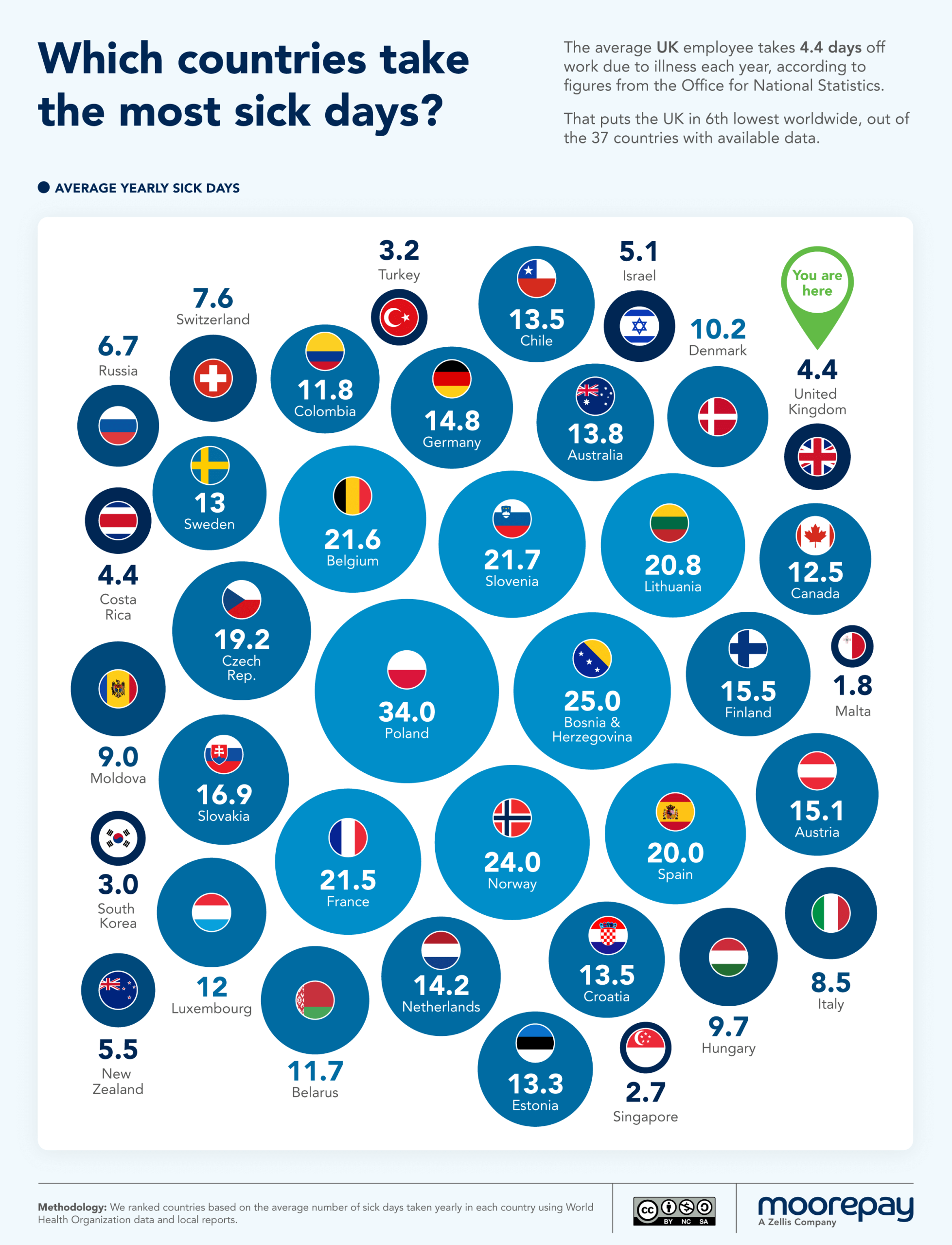
Next, we used World Health Organization (WHO) figures to compare the number of sick days taken by the average worker in each country. WHO maintains this data on 37 countries, and of these, Poland has the highest absentee rate, with the average worker taking 34.0 days off.
The employer is obliged to pay most Polish employees under 50 sick pay at 80% of their salary for the first 33 days of leave in a given year, after which Poland’s Social Insurance Institution (ZUS) takes over; for those over 50, responsibility to pay switches to ZUS after 14 days. Since January 2025, ZUS has had stronger powers to monitor the veracity of sick pay claims, including checking workers’ social media posts for clues that they are on holiday or renovating their home. In 2024, ZUS suspended around 640,000 PLN (£131,273) in sick pay for false claimants.
Sick Leave Trends in the UK
The UK is among the countries with the fewest sick days. Of the 37 countries with available data, only five take fewer sick days than the 4.4 that the average UK worker takes. (Costa Rica’s figure is fractionally less than 4.4). This equated to 148.9 million days of sick leave in 2024, which the Office for National Statistics notes is a “decrease of 14.9 million from 2023 and an increase of 9.9 million from the pre-coronavirus 2019 level.”
While the number of sick days has fallen in the short term, the UK’s mid-term trend towards more sick days has been attributed to an ageing workforce and to funding and organisational issues in the National Health Service (NHS).

Chapter 4
Explore our data on international sick pay
In this chapter you’ll learn
- Why doctors at the dawn of the welfare age were nervous about sick leave.
- Why over half of UK employers offer additional sick pay.
- How to explore our full data on sick pay around the world.
When the UK’s NHS and National Insurance scheme were first developed in the 1940s, one GP joked in The Lancet that the “government is going to control the doctor, because if the doctor were not controlled, he might be ‘lax or dishonest’ or worse still, he might treat his patients with kindness and humanity.”
Eighty years on, the flat rate of sick pay feels equally blunt, leaving those with higher monthly expenses at a greater loss. But the present rate of £118.75 per week (after the first three days) leaves even lower-income households short of the cost of food, housing, fuel and power, according to the Health Foundation (using government figures). This explains, in part, why just over half of employers offer an occupational sick pay scheme on top of the statutory requirement.
You can use this interactive table to compare the UK’s statutory sick pay against other countries in GBP or converted to international dollars to allow for local purchasing power.
Proposals to Strengthen the UK’s Sick Pay System
The Health Foundation has recommended raising the UK’s minimum sick pay to at least 80% of an employee’s regular earnings, noting that the cost would remain under 0.4% of total pay. It’s a solution that would affect smaller businesses disproportionately, which is why small business owners should advocate for shared financial responsibility with the government – for their own good and the good of their employees.
As it stands, the rate of £118.75 will remain the same when UK sick pay laws are updated in 2026, although at least the lowest-paid workers will become eligible. For now, over one million UK workers earn below the present threshold of £125 per week and cannot access SSP. But for them, as for others, SSP may not be enough to cover their bills, which exacerbates issues of presenteeism, sporadic leave and long-term inability to work.
The current low rate of sick pay compels some people to work while they are unwell to make ends meet. This risks compounding existing health conditions and can lead to people dropping out of the labour market altogether.”
Says Alice Martin, Head of Research at the Work Foundation.
PAST WEBINAR
Demo | Stop manually managing absence
Want to know the real impact absence is having on your business? Struggling to visualise your absence data and still managing it all manually? Stop! From reporting on absence to spotting trends and supporting employees through absenteeism. You need software that covers it all.
Reduce the risk of non-compliance, ensure accurate employee payments, and stay on the right side of legislation. All with our easy-to-use software.
Check out our award-winning HR & Payroll Software in this demo. We’ll show you how we take absence management from poor to pro!


Chapter 5
Frequently asked questions
In this chapter you’ll learn
- Frequently asked questions about minimum wages across the world.
- Methodology and sources of this report.
FAQs
Presenteeism is when employees work through illness or injury instead of taking time off to recover because they can’t afford to take the time off or fear consequences to their career.
From April 2026, statutory sick pay (SSP) will be paid from the first day of illness, instead of going unpaid until the fourth day. Plus, the lower earnings limit of £125 per week will be removed so that all employees will be eligible for statutory sick pay.
Luxembourg offers the highest first week of sick pay at an average of £1,107.29 (€1,279.81), based on somebody earning the country’s average salary.
The U.S., South Korea and Tunisia have no statutory sick pay.
The first week of UK sick pay is equal to Intl$69.92 in international dollars, which allows for local purchasing power. By this metric, the UK’s sick pay compares even more poorly to those around the world – and is on a par with Mexico and Cambodia.
The World Health Organization reports that Polish workers take an average of 34 sick days per year, which is the highest figure of the 37 countries with available data.
The average UK employee takes 4.4 days off sick each year, according to WHO and Office for National Statistics data.
Methodology & Sources
To find out which countries have the best statutory sick leave pay, we carried out manual research to look for the sick pay legislation in every country.
We calculated the amount of sick pay a resident would receive for the first week (five working days) of sick leave. Many countries have a waiting period whereby you don’t receive pay for the first few days of sick leave, reducing those countries’ figures. Where sick pay was applicable at a given percentage of income, we used the national adjusted net income per capita for each country (from the World Bank) to reach a figure. In situations where multiple compensation bands (percentage rates) were stated depending on the number of insured years, we took the maximum value. Where pertinent, we assumed the cause of illness was “general” rather than “occupational.”
Once we had figures for each country in the local currency, we converted them into U.S. Dollars, GBP and international dollars (applying World Bank Price Parity exchange rates) for additional comparisons. The latter is used to compare sick leave pay across countries while accounting for the cost of living.
In addition, we ranked countries based on the average number of sick days that are taken yearly in each country. The data was partially taken from the World Health Organization’s dataset, with the remaining countries sourced from local reporting.
Data is correct as of October 2025.
Contents
Jump back to the chapter you want to re-read.