Global unfair dismissal protection report 2026
Which countries offer the best unfair dismissal protections?
The qualifying period for unfair dismissal protection in the UK will shorten from 24 months to six months from January 2027. But how does this compare to other countries? Moorepay consulted official sources around the world to find out.

Contents

Chapter 1
Introduction
In this chapter you’ll learn
- What unfair dismissal is.
- The change to unfair dismissal protection in the UK.
- How we compared unfair dismissal protection around the world.
Unfair dismissal happens when an employer lets a worker go with no fair or justifiable reason, or without following a fair procedure.
If a worker feels they’ve been dismissed unfairly, they may be able to challenge the decision through their employer’s appeal process, an employment tribunal or other means, depending on what country they are in – and how long one must work to be eligible for unfair dismissal protection in that country.
Some countries offer unfair dismissal protection from day one in a new job; for some it kicks in after a few months. In others – the U.S., for example – there is no protection of this precise nature at all. In the UK, the qualifying period has been set at 24 months since 2012 but will be reduced to just six months from January 2027.
To compare worker rights around the world, Moorepay consulted official sources in 71 major countries and compared the qualifying period for unfair dismissal protection for a typical employee under statutory law.
Key findings
-
6The number of months UK workers will need to be in a job to get unfair dismissal protection from January 2027.
-
0There is no wait time before protection begins in countries such as Norway, Canada and Japan.
-
12The number of months new employees must wait before unfair dismissal protection begins in Denmark, Greece and Ireland.

Chapter 2
How does the UK’s unfair dismissal protection compare globally?
In this chapter you’ll learn
- Which countries have the longest unfair dismissal protection qualifying period.
- The countries that have no unfair dismissal protection of this type.
- How the UK’s protection period has changed over the past half-century.
First, we compared the qualifying period for unfair dismissal protection in 71 major countries to see how they stack up.
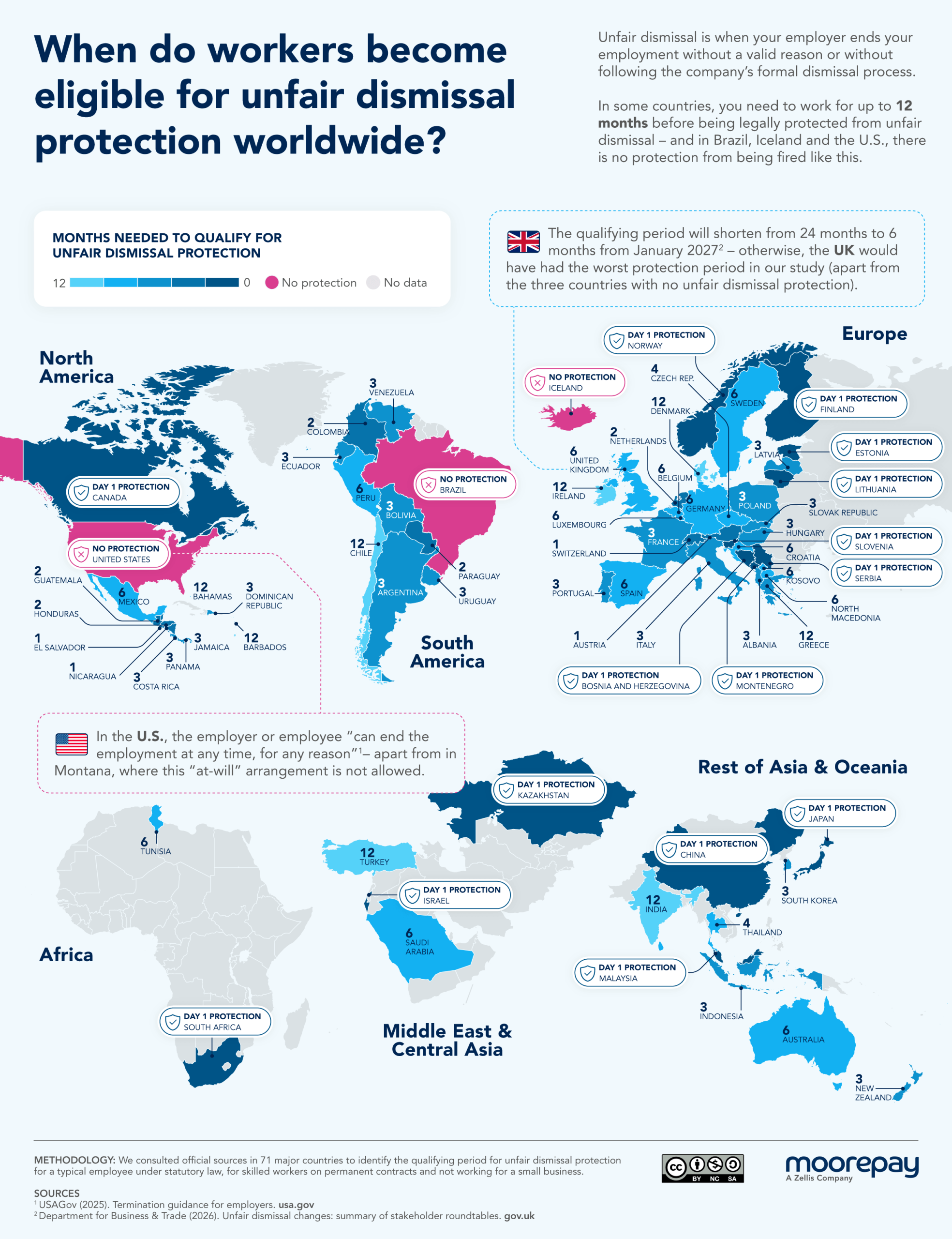
The longest qualifying period is 12 months, as found in eight countries, including Barbados, Chile and Denmark. In others, including Japan, Kazakhstan and South Africa, protection begins immediately when you start a new job.
Brazil, Iceland and the United States offer no unfair dismissal protection of this type. The U.S. (apart from Montana) maintains a system of ‘at-will’ firing, although it is illegal to dismiss someone on discriminatory grounds (race, sex, age, etc.) or for whistleblowing. A contract or appropriate union agreement may offer further protection. Public sector employees are also exempt from at-will employment in the U.S.
In the UK, the qualifying period was set at 24 months under the Industrial Relations Act 1971, and it has fluctuated between six and 24 months under successive governments. Most recently, it was reduced to six months in 1999, before returning to 24 months in 2012.
At 24 months, the UK’s qualifying period would have been twice as long as any other country in our study, with Denmark, India and Ireland among eight countries in our study that have a 12-month period. But from January 2027, the qualifying period will be reduced to six months, putting the UK on a par with 13 other countries, including Australia, Belgium and Mexico.

Chapter 3
How the UK’s new unfair dismissal protection period measures up in Europe
In this chapter you’ll learn
- The European countries where unfair dismissal protection is delayed the longest.
- The exception to the qualifying period in Ireland.
- Which European countries offer day one protection to workers.
There are three European countries where unfair dismissal protection takes one year to kick in: Denmark, Greece and Ireland. In Ireland, it is sometimes possible to make a claim against unfair dismissal before that 12-month period has elapsed; however, the court’s decision is not legally binding, and the outcome remains at the will of the employer.
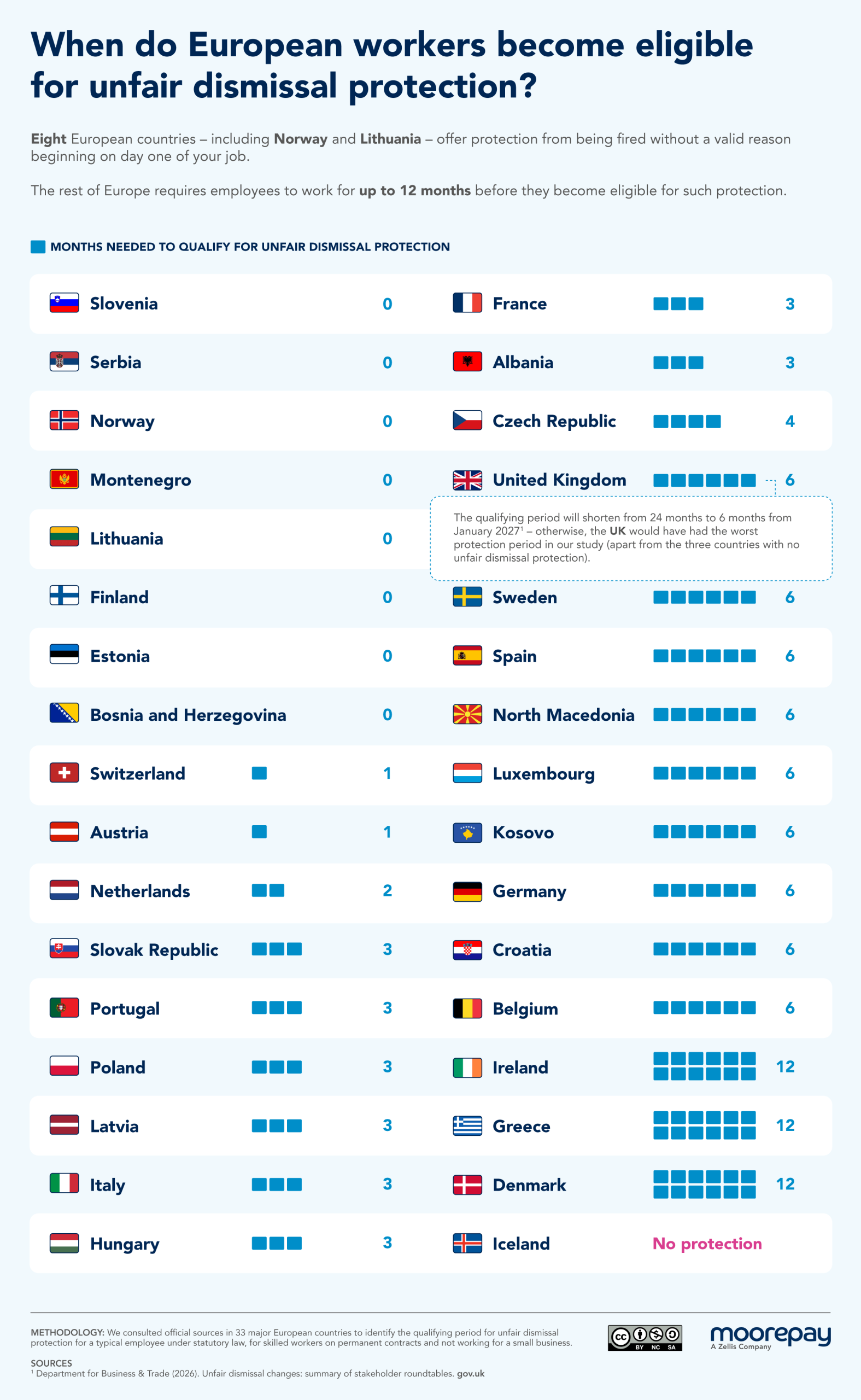
In Austria and Switzerland, unfair dismissal protection comes in after just one month of work. However, we also found eight European countries where protection begins on day one, mainly among Balkan, Baltic and Nordic states – although not including Denmark (12 months) or Sweden (six months), among others.
By reducing the qualifying period from 24 months to six, the UK goes from being the European country with the longest period to nestling at the midway point, among eight other countries, including Belgium, Croatia and Germany.
Read more about unfair dismissal
-

Unfair dismissal under the ERA
With the qualifying period for ordinary unfair dismissal due to reduce from two years to six months, employers will have a much shorter timeframe to identify and address performance concerns.
-

The Employment Rights Act: what you need to know
This ultimate guide breaks down everything you need to know about the Employment Rights Act including what’s changing, when the new rules will take effect, and how employers, HR and payroll teams can prepare.

Chapter 4
What to do if you’ve been unfairly dismissed
In this chapter you’ll learn
- How to appeal unfair dismissal.
If you believe your UK employer has dismissed you unfairly, you should begin by entering the employer’s appeal process. You can also access legal advice through Citizens Advice or your union, if you have one.
And it is worth knowing that exceptions to the UK’s unfair dismissal protection qualifying period do exist. For example, ‘automatically unfair’ reasons, health and safety issues, certain cases of being fired for taking industrial action or constructive dismissal do not require you to serve a qualifying period before becoming eligible to claim.
As an employer, you can read about how to avoid unfair dismissal claims here.
PAST WEBINAR
The ERA Blueprint Series: unfair dismissal reforms
From January 2027, ordinary unfair dismissal protection is expected to move from two years to six months, meaning the first few months of employment will become a much more critical window.
Here’s what’s changing, what it could mean for your organisation and how to build a response that stands on solid ground.

Chapter 5
Frequently asked questions
In this chapter you’ll learn
- Frequently asked questions about unfair dismissal protection.
- Methodology and sources of this report.
FAQs
The qualifying period will fall from 24 months to six months as of January 2027.
Several countries offer day-one protection for employees. These countries include Bosnia and Herzegovina, Canada, China, Estonia, Finland, Israel, Japan, Kazakhstan, Lithuania, Malaysia, Montenegro, Norway, Serbia, Slovenia and South Africa.
The UK will have the longest qualifying period (24 months) until January 2027, when the period will fall to six months. The qualifying period is 12 months in the Bahamas, Barbados, Chile, Denmark, Greece, India, Ireland and Turkey.
Brazil, Iceland and the United States have no protection of this type.
Methodology & Sources
We consulted official sources in 71 major countries to compare the length of the qualifying period for unfair dismissal protection for a typical employee under statutory law. Data is correct as of September 2026.
We applied the following logic in each country:
- The qualifying period for unfair dismissal protection was defined as the length of employment needed before employers are legally required to provide valid, justifiable reasons for dismissal.
- Where unfair dismissal protection only activates after a probation period, we assumed the probation period was the maximum length.
- We assumed the employee was on a permanent contract.
- We assumed the employee was a ‘skilled’ employee rather than a manual labourer.
- We assumed the employee didn’t work for a small business.
- We ignored more favourable rules that only apply to employees in select regulated industries or only public employees.
THE ULTIMATE GUIDE TO REDUNDANCY
Read more about the redundancy process
From explaining what redundancy is to mapping out the entire process to outlining the legislation, the pay, the pitfalls and the alternative options – it’s all here.