Employment Rights Act ultimate guide for HR and payroll
This ultimate guide breaks down everything you need to know about the Employment Rights Act (formerly Employment Rights Bill), including what’s changing, when the new rules will take effect, and how employers, HR and payroll teams can prepare.

Contents

Chapter 1
Introduction
In this chapter you’ll learn
- An overview of the Employment Rights Act and it's current status
- A summary of what this guide will include and the experts behind it
Why is the ERA significant?
The Employment Rights Act is one of the biggest shake-ups to employment law in UK living memory. It impacts nearly every employer and a wide range of workplace practices, including statutory payments and day-one worker’s rights – amongst many more.
The Act was published on 10 October 2024 and was heralded as the “biggest upgrade of workers’ rights in a generation”. This was due to modernising many workplace regulations, aiming to create more flexibility for employers and security for workers, particularly at the start of their employment.
Although bringing big benefits, these changes pose a threat to HR and payroll teams who are unprepared. Like with all laws, businesses and organisations are required to keep up with the changes, or risk non-compliance and the penalties that follow. This may mean altering your habitual HR processes and upskilling your managers.
In this ultimate guide, we detail everything you need to know about the ERB as an employer, HR professional, or payroll professional. We start with the latest update, then summarise what each of the changes are, and when they will occur. You can also find some handy takeaways, such as a roadmap[link] and mini guide[link], to download and keep handy.
Key points
Your experts
Meet the HR and payroll experts who wrote this guide.
Patrick Cunningham
Head of HR Operations, HR Services
Patrick has over 15 years’ experience in HR, specialising in leadership, organisational development, and employment law. He supports clients with restructures, compliance, and strategic HR advice.

Laura Sheldon
Senior Manager, Employment Law
With 20+ years in HR and employment law, Laura leads our Legal team. She specialises in tribunal claims, ACAS conciliation, and complex legal cases. Laura’s industry experience spans education, healthcare, and NGOs.

Cybill Watkins
Product Legislation Manager
Cybill is Group Product Legislation Manager at Zellis Group, which includes Moorepay, Zellis, and Benefex. She’s a self-described payroll geek with an obsession for payroll and HR laws, which she uses to advise and educate on everything legislation, both within the team and externally. She’s also an advocate of neurodiversity in the payroll industry.

Your ERA roadmap
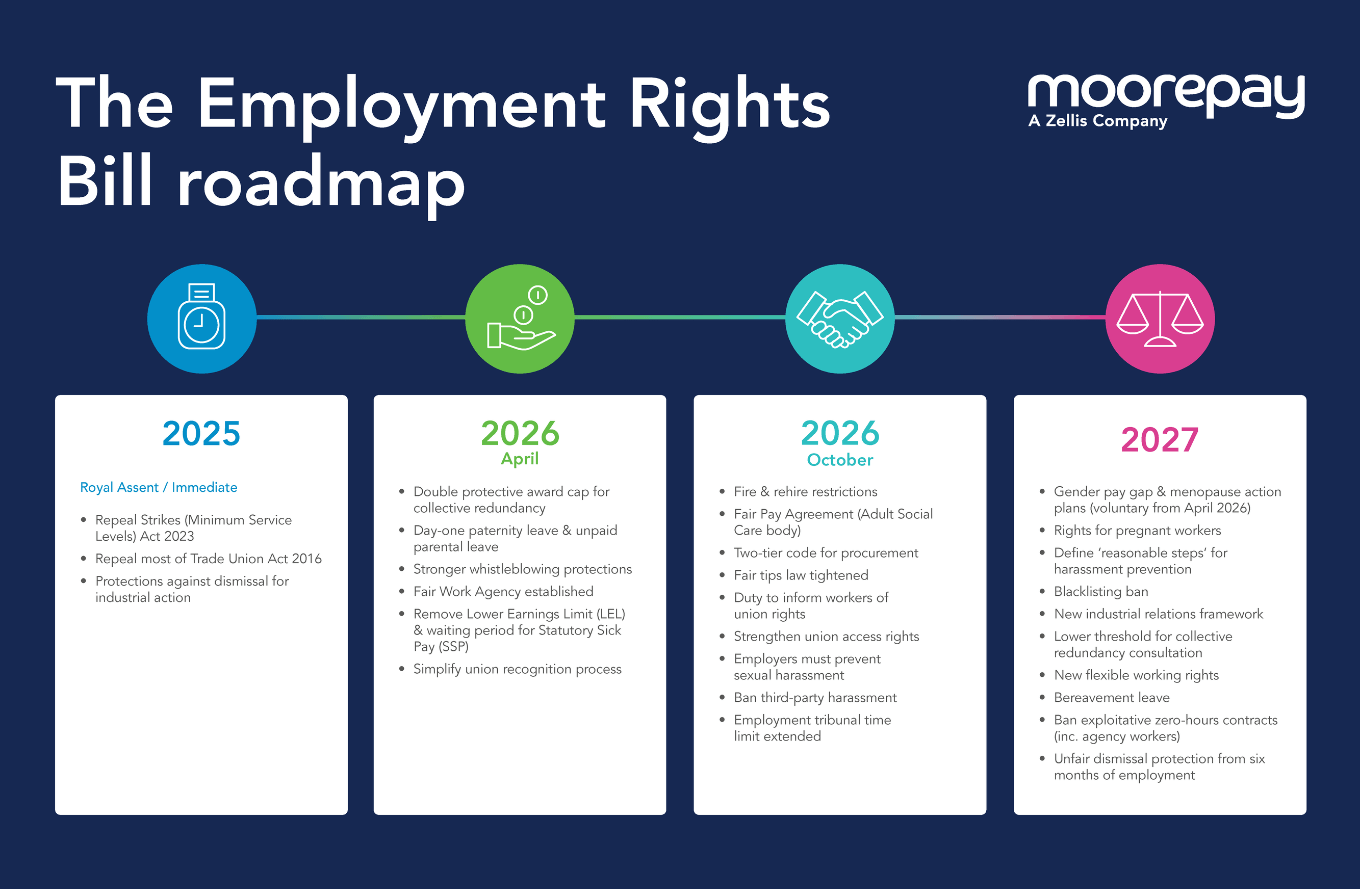
Following the government’s recently published ERA timeline, we’ve condensed the key details into a clear, practical roadmap that helps HR and payroll teams understand what’s changing, when it’s happening, and what really matters most.
What’s the status of the Act right now?
The ever-changing Employment Rights Bill has now received Royal Assent
After clearing the House of Lords on 16 December 2025, the Employment Rights Bill received Royal Assent on 18 December 2025 and became law as the Employment Rights Act 2025.
Having faced strong opposition, the Government stepped back from its original day-one unfair dismissal proposal. Instead, the qualifying period has been set at six months, with the Government committed to introducing this from January 2027 (currently expected from 1 January 2027).
Many parts of the Act will still rely on secondary legislation. One controversial area that remains in the plan is the removal of the cap on unfair dismissal compensation.
In response to concerns, the Government has committed to publishing an impact assessment before implementing this part of the Act, so the timing of this change still carries some uncertainty.
The changes started in Autumn 2025 and continue throughout 2026 and 2027, in a phased approach.

Chapter 2
How employers and employees are reacting
In this chapter you’ll learn
- How prepared employers feel for the ERA
- Which parts of the Act worry them most
- Employee opinions on the Act
Employer preparedness for the ERA changes
-
54.3
are feeling prepared
-
21
are feeling unprepared
-
7.5
haven’t heard of the ERB at all
It seems employers and HR professionals feel they have some catching up to do – which is not surprising, given the magnitude of the Act.
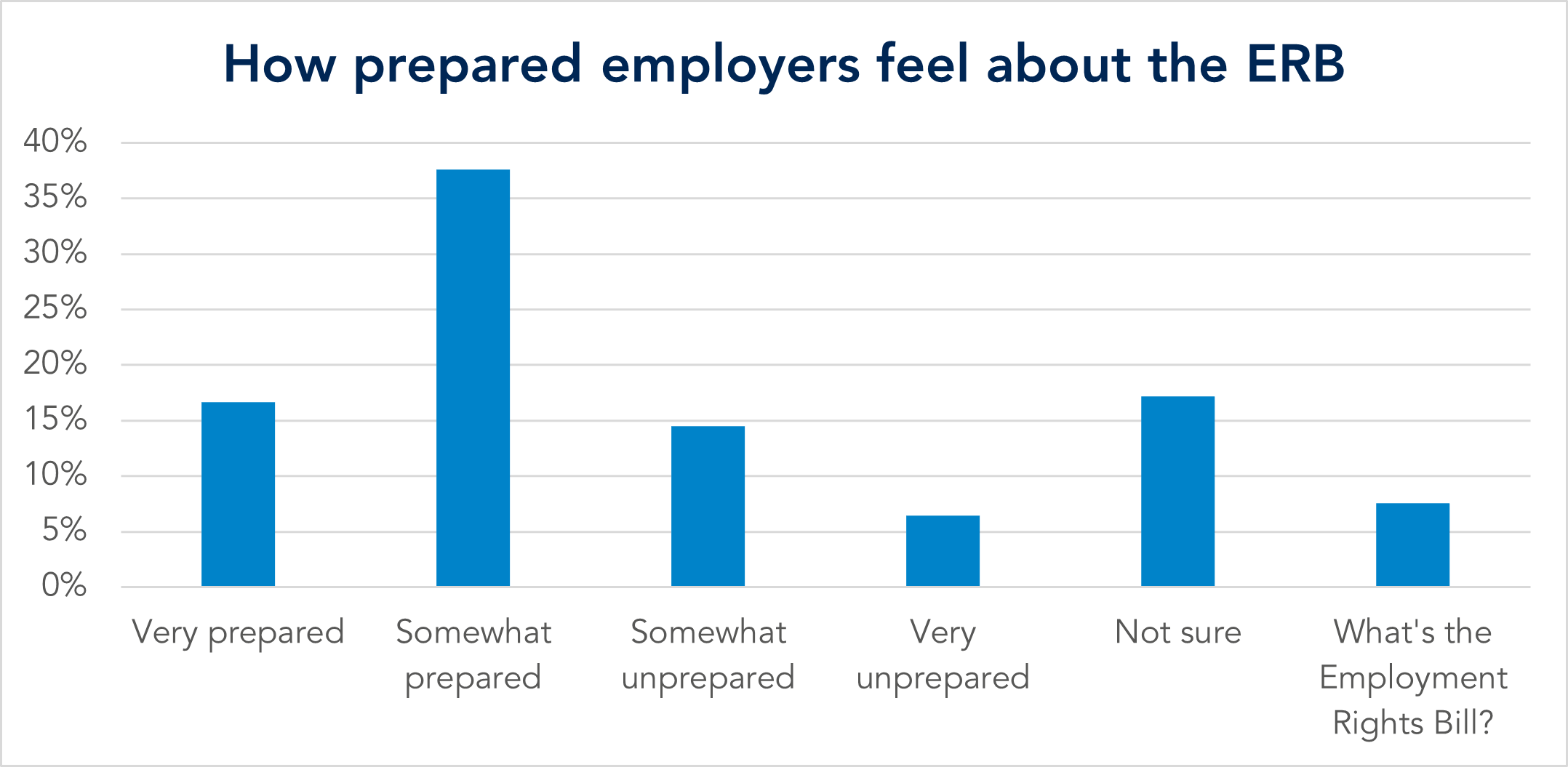
Based on first-hand research conducted by Moorepay in November 2025, when asked: “How prepared do you feel about the Employment Rights Bill coming into effect?” the majority (54.3%) of employers are at least somewhat prepared for the Bill coming into effect. This included 37.6% being somewhat prepared, and 16.7% being very prepared.
On the other hand, over 1/5 of employers are feeling unprepared for the changes, with 6.5% of employers reporting feeling very unprepared for what’s ahead.
If you’re just learning about the ERB in this guide, you’re not alone! A concerning 7.5% of employers report that they’ve not heard of the Employment Rights Bill at all.
What parts of the ERB employers are worried about
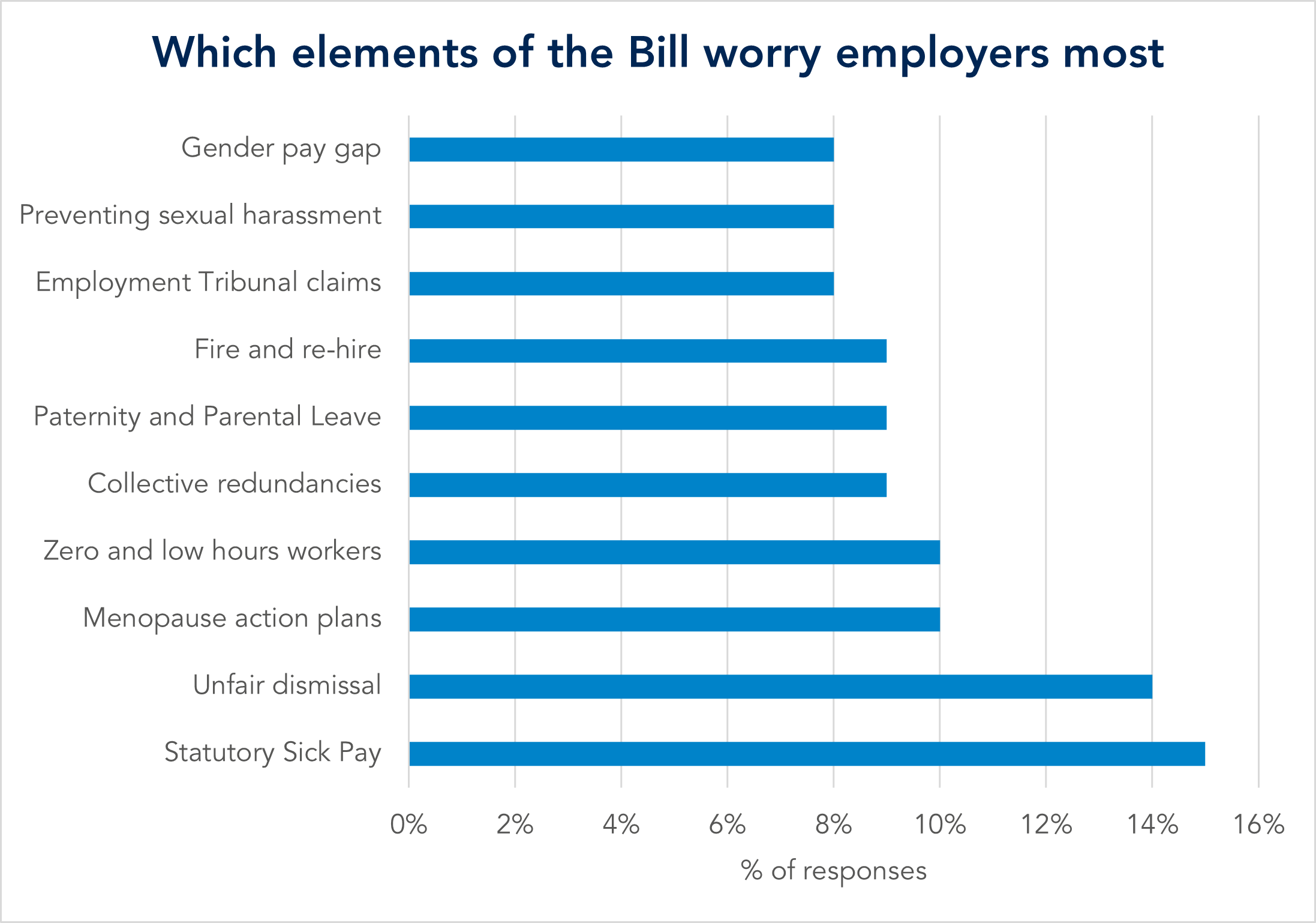
It seems each element of the Bill listed in our survey causes distress for at least some employers, as every answer was selected by at least 8% of the respondents.
When asked “Which elements of the Bill worry you most?”, the most common answer was statutory sick pay at 15%, closely followed by unfair dismissal at 14%. However, all answers were selected by a proportion of respondents – showing each aspect of the Bill worries at least some employers.
The least common answer was new reporting requirements for the Gender Pay Gap at 8%, which may be because it applies to larger employers, rather than all businesses.
What parts of the ERB employees think will impact them most
It’s important to remind ourselves that although this shake-up in employment law may be seen as a difficult time for HR and payroll teams, it will in many ways greatly improve the working lives of workers and employees. Therefore, we asked which parts of the Bill employees think will impact their working lives the most.
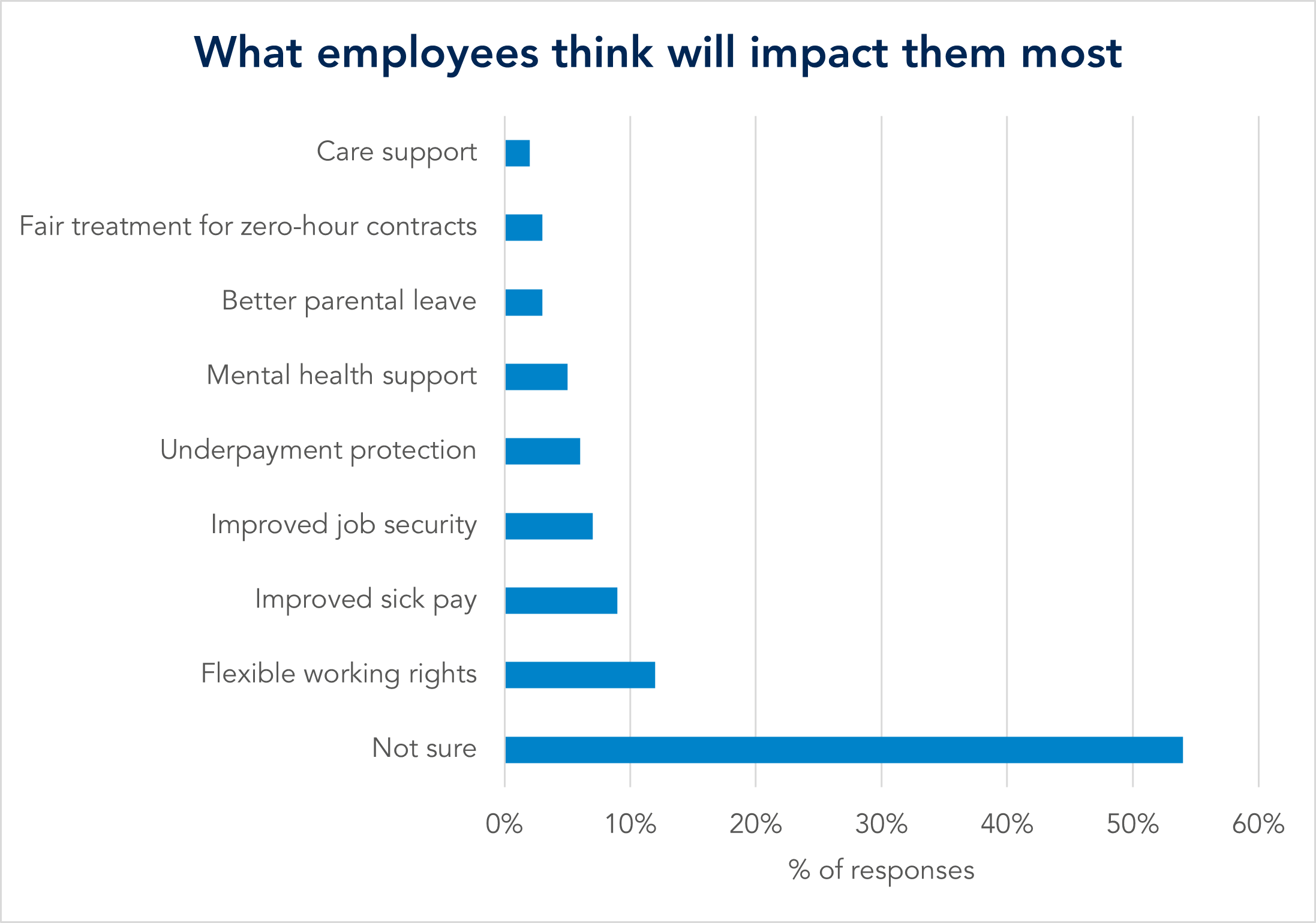
Although the majority (54%) weren’t sure, the winner was flexible working rights at 12%, followed by improved sick pay and improved job security.
The least popular response was care support, again perhaps because this support applies to fewer people (although it will make a big difference to those impacted if and when it’s put into effect).
Survey methodology
Moorepay conducted first-hand research for the insights above.
The anonymous survey collected responses from 2,000 participants who visited our website, using a pop-up form. The survey ran on our website for two weeks in November 2025. Both employees and employers were included in the sample, and their results were separated for the analysis above.

Chapter 3
Changes introduced by the ERA
In this chapter you’ll learn
- Changes to worker protections and enhanced rights
- How businesses will be taking greater accountability
- Impacts on trade union support and strikes
Worker protections and enhanced rights
Day-one rights (April 2026 and 2027)
A number of things will become a day-one right in the UK, meaning a worker is eligible for these benefits immediately on their first day of employment.
- Unpaid Parental Leave will become a day one right in April 2026.
- Paternity Leave will also be available from day one of employment in April 2026.
- The restriction on taking paternity leave and pay after shared parental leave is likely to be removed too, so the two types of leave can be taken back-to-back.
- Flexible working requests will also be available to make on an employee’s first day.
- Statutory Sick Pay (SSP) will be payable from the first day of absence, instead of the fourth. It will be extended to all employees regardless of earnings – i.e. the lower earnings limit will be removed.
- Statutory Maternity Pay will now become a day one right, removing the 26-week qualifying period before workers can be eligible for pay.
Note, the rate of Statutory Paternity Pay will not be increased and still requires a 26-week qualifying period. Paternity leave will not be increased to six weeks, although these were all considered initially as part of the proposal.
Bereavement leave (2027)
The Act will expand rights to bereavement leave to those who experience pregnancy loss at any stage during their pregnancy, changing from the current 24-week qualifying period.
Flexible working (2027)
Employers wanting to refuse a flexible working request will have to state the reasons, and explain why their refusal is reasonable.
This is in addition to it soon being a day one right.
Fire and rehire (October 2026)
Also known as dismissal and re-engagement. New restrictions apply on dismissal and re-engagement when making contractual changes, which will make dismissing someone then rehiring them with worse terms an automatically unfair dismissal.
Sexual harassment / Worker Protection (Amendment of Equality 2010) Act (October 2026)
- Employers will be required to take “all reasonable steps” (not just “reasonable steps”) to prevent sexual harassment in the workplace.
- There’s a new duty for employers to prevent sexual harassment from third parties, such as customers, in October 2026.
- But what are reasonable steps? We’re expecting the law to outline this in 2027.
Protection for pregnant workers (2027)
Strengthened protections against dismissal for pregnant workers and those returning from maternity leave is coming in 2027.
Collective redundancies (April 2026 / 2027)
- Maximum period for protective awards doubled from 90 days’ pay to 180 days’ pay in April 2026.
- New trigger points introduced to collective redundancy consultation in 2027.
- From 2027, employers will be required to consider redundancy and redeployment options across the whole organisation, not just within the affected workplace.
- In 2027 there will also be increased protection for collective redundancies of workers on ships that are registered outside of Great Britain, but operate regularly UK ports.
Zero and low hours workers (2027)
There will be strengthened rights for zero hours, low hours, and agency workers. This includes the right to guaranteed hours if the worker wants them.
Read more in our guide and blog article.
Cancelled shifts compensation (2027)
Employers must:
- Give reasonable notice of shifts, and
- Pay compensation for cancellations.
Carer’s leave (2026)
- “Caring” may be added as a protected characteristic in the Equality Act.
- Paid carer’s leave will be reviewed. This will build on the unpaid leave introduced in 2024, enabling employees to take 1 week off in a rolling 12-month period for planned caring responsibilities.
Adult social care
- Introduces a fair pay agreement for adult social care.
- There may also be a new negotiating body for adult social care in October 2026.
Mandatory Seafarer’s Charter (December 2026)
The only update in December 2026 is expected to be a new mandatory charter for seafarers, implementing more stringent measures around health and safety, pay, job security and rest breaks.
BLOG ARTICLE
The Employment Rights Bill: what you need to know
The Employment Rights Bill is evolving fast, with Government U-turns already emerging since the Autumn Budget.
Discover what this means for unfair dismissal rights and how employers can get ahead of the changes in our latest blog.

Greater accountability for businesses
Limits on non-disclosure agreements (April 2026)
This will significantly limit non-disclosure agreements (NDAs), making them void if they prevent workers from discussing workplace harassment, discrimination, or abuse.
Whistleblowing (April 2026)
Sexual harassment is expected to become a ‘qualifying disclosure’ under whistleblowing law. This will mean protection from detriment and unfair dismissal for whistleblowers making a sexual harassment disclosure. (April 2026.)
Single enforcement body – the Fair Work Agency (April 2026)
The Fair Work Agency is expected in April 2026 to bring together existing enforcement bodies and take on enforcement of other employment rights, such as holiday pay and statutory sick pay.
Employment Tribunal claims time limit (October 2026)
The time limit between the act to making a claim will be extended from three months to six months for (most) employment tribunals.
Right to be accompanied
Currently, employees have a right to be accompanied to disciplinary and grievance hearings by a colleague or trade union representative. The Act is currently reviewing expanding who can be a companion, which is expected to be proposed to Parliament within six months of the ERB passing.
Gender pay gap and menopause action plans (2027)
Equality Action Plans will become voluntary in April 2026, and mandatory for large employers in 2027. This should include measures businesses should take to address the gender pay gap and supporting employees going through menopause and menstruation.
Tipping (October 2026)
- Employers will need to consult with workers or their representatives before creating a tipping policy.
- They will also need to update their tipping policy every 3 years.
Public sector outsourcing ‘two-tier code’ (October 2026)
New measures are expected for public sector outsourcing, to avoid having different terms and conditions for ex-public sector employees and private sector employees.
Regulation of umbrella companies (2027)
The definition of agencies may be expanded to include ‘umbrella companies’, allowing enforcement by the relevant bodies.
After expert employment law advice?
Prepare for upcoming employment law changes with our tailored Employment Rights Act consultancy.
Trade union support and strikes
Detriment protection from industrial action (February 2026 / October 2026)
- Dismissal protection for industrial action will increase from February 2026. That means dismissal for taking part in industrial action becomes ‘automatically unfair’. This will remove the current 12-week limit for claiming unfair dismissal.
- Workers will be protected from unfair dismissal regardless of strike duration, with employers required to justify dismissals unrelated to industrial action.
- It’s expected that this protection will expand to workers being protected from detriment (treated less favourably by their employer) in October 2026.
Other trade union activities (from Autumn 2025)
Various aspects of trade union legislation has been altered.
- The notice time of industrial action will reduce from 14 to 10 days. (February 2026)
- Unions will need a simple majority to vote for industrial action. (Autumn 2025)
- Picket supervisors will no longer be required.(February 2026)
- Industrial action mandates will last for 12 months, instead of 6 months.(February 2026)
- Industrial action and ballot notices will be simplified. (Autumn 2025)
- Political fund rules will change. (Autumn 2025)
- Strengthened rights for union representatives to reasonable paid time off and access to workplace facilities and accommodation. (October 2026)
- Expanded to include lists generated by AI and third-party compilers, even if not originally intended for discriminatory use.
- A formalised process for unions to request workplace access, with enforcement and penalties managed by the Central Arbitration Committee (CAC). (October 2026)
- Employers must inform all workers of their right to join a union. (October 2026)
- Lower thresholds and streamlined procedures for union recognition, with new protections against unfair practices and mass recruitment tactics.
- Removal of 10-year review ballots; new members automatically opted in with the right to opt out.
- Reduced reporting requirements for unions, easing compliance.
- Allowing trade union members to vote electronically. (April 2026)
- Extending protections for trade union members from being discriminated or ‘blacklisted’. (2027)
- Introducing a new industrial legal regulations framework. (2027)
Minimum service levels for strikes (not in effect)
The rules proposed around minimum service levels for strikes (i.e. keeping service levels running when there’s a strike) were removed immediately on 18 December 2025.

Chapter 4
How to prepare for the Act
In this chapter you’ll learn
- What you can do from both HR and payroll perspectives to stay ahead
What HR need to do to prepare
If you’re responsible for HR in your business, here are a few things to put in place whilst we wait for the outcome of the Act:
Review contracts and policies
Review every contract, handbook and policy to ensure they reflect day-one rights, dismissal protections and updated sick pay rules.
Any reference to qualifying periods or outdated entitlements should be replaced.
Getting the paperwork right early will make compliance far easier once the reforms take effect.
Equip line managers
Managers sit at the centre of compliance. They need to understand the new obligations around fair dismissal, absence management, harassment prevention and thorough background checking.
Focus training on practical skills such as:
- Conducting fair reviews
- Recording evidence
- Handling conversations confidently
- Knowing when to escalate concerns
Strengthen governance and risk management
Review your risk register to include potential exposure around whistleblowing, harassment and tribunal claims.
Document how your organisation is responding to each reform and put measurable actions in place.
Regular reviews and reporting will provide evidence of compliance if questions arise later.
Prepare for consultation requirements
Look closely at your consultation processes, from redundancy and flexible working to union recognition.
Meaningful engagement means early involvement, clear communication and visible follow-up.
A well-documented process can be your strongest protection if decisions are challenged.
Engage with legal & payroll professionals
No single department can manage these reforms alone. Work closely with your legal and payroll teams to make sure contracts, processes and policies are fully aligned.
The financial penalties for non-compliance will be severe, and for some businesses enough to shut the doors. Acting now is the best safeguard.
Find out more: https://moorepay.turtl.co/story/what-the-employment-rights-bill-means-for-hr-mini-guide-cc/page/1
PAST WEBINAR
What the Employment Rights Act means for HR
Watch this Smart Talk to gain some practical guidance and top tips from our highly qualified experts.
We’ll walk you through auditing your contracts & policies, training your line managers, updating risk registers and preparing for consultations.

What payroll professionals need to do to prepare
If you’re responsible for ensuring your workers get paid, here’s what you need to do:
Update your payroll system
Many of these changes, particularly around SSP, leave entitlements, and predictable working patterns, will require updates to payroll systems and processes.
Check in with HR
Payroll teams should work closely with HR to ensure employees understand how changes affect their pay and rights.
Stay up to date
The roadmap outlines phased consultations running through 2025-2026, meaning final details could shift. Staying informed will help you prepare for updates.
The majority of regulations will come into effect on the common commencement dates of 6 April or 1 October, but some measures (e.g., the Mandatory Seafarers Charter) have specific timelines such as December 2026.

Chapter 5
Frequently asked questions
In this chapter you’ll learn
- Frequently asked questions about the Employment Rights Bill
FAQs
Not necessarily. If your company offers occupational sick pay (company sick pay) for the first few days of absence, this usually counts as enhanced sick pay. In some circumstances, you can offset SSP against what you already pay rather than paying both. For example, if SSP is greater than company sick pay, you pay SSP. But make sure your policy clearly explains how this works in these specific situations.
Your absence policy should clearly explain how employees report sickness, what evidence is needed, and what happens if they don’t follow the process. SSP entitlement won’t override your right to treat unexplained absences as unauthorised.
However, ensuring you have accurate absence records, with a focus on supporting and addressing absences, are key enablers in addressing absence issues. In short, consistency and clear communication are key.
Currently, employers can decide the length of probationary periods because there is no statutory requirement. However, the Employment Rights Act (ERA) will introduce changes to this.
The Act removes the two-year qualifying period for unfair dismissal claims, meaning employees could have protection from six months of employment.
It also looks to create statutory guidelines around probation periods, which is currently the source of tension between the House of Commons and House of Lords.
Not at the moment. The existing threshold for collective consultation remains at 20 or more redundancies within 90 days.
It’s still good practice to consult properly, even when dealing with smaller numbers, but no new rules have been confirmed yet.
The Act strengthens protection against third-party harassment, including by customers or clients. Update your harassment policy, train staff on reporting procedures and assess risks for public-facing roles.
Encourage openness and make sure support is available for anyone affected.
Employers with 250 or more employees will need to publish gender equality and inclusion plans, including menopause support. Smaller businesses aren’t yet required to do this but are encouraged to adopt similar practices as part of good inclusion strategy.
Yes. The Fair Work Agency will oversee compliance with employment rights across both public and private sectors.
It will have powers to request records and investigate issues, so employers of all sizes should make sure their documentation is complete and accessible.
If you employ UK-based staff, you’ll still fall under the Agency’s remit. Inspections may happen remotely, so you’ll need to keep employment and payroll records well-organised and easily shareable in digital form.