UK salary report 2026
The salary needed to live comfortably in UK cities
The 50/30/20 household budgeting guideline is a simple way to allocate your income to your needs and wants while putting aside money for savings. But where in the UK is the cost of living low enough — and the average salary high enough — for the 50/30/20 framework to be feasible?

Contents
-
Chapter 1
Introduction
-
Chapter 2
How much does a single person need to live comfortably in UK cities?
-
Chapter 3
The cities where the average salary exceeds what’s needed to live comfortably
-
Chapter 4
The household income a family of four needs to live comfortably
-
Chapter 5
How the salary needed to live comfortably varies between London boroughs
-
Chapter 6
Examine the data on the gap between the ‘comfortable’ salary and local average incomes
-
Chapter 7
Frequently asked questions

Chapter 1
Introduction
In this chapter you’ll learn
- What the 50/30/20 home budgeting rule is.
- How to define a 'comfortable salary'.
Experts ranging from major UK banks to the United Nations Federal Credit Union suggest trying the 50/30/20 home budgeting rule to save money while covering essential needs.
One big benefit of this system is that it is straightforward, letting you divide your expenses into three categories: needs, wants and savings. Those using the system should aim to allocate 50% of their income to cover their needs (or ‘outgoings that you cannot avoid, or things that you’d struggle to live without’), such as housing, bills and essential groceries; 30% to leisure, pleasure and non-essential ‘wants’ such as gifts and treats; and 20% to savings.
Of course, the ability to meet these budgeting constraints depends on your income and the local cost of living. And for employers, accounting for the local cost of living when setting salaries can help to attract the best talent and retain those they already employ.
So, for our latest study, Moorepay defined a ‘comfortable salary’ as one that pays enough to cover essential costs while leaving 50% for wants and savings. And we used the LiveWhere calculator to determine the cost of living (i.e., essential needs) in 48 major UK cities for single professionals and families. By doubling this cost of living figure in each case, we were able to find the earnings needed to live comfortably in each city.
Key findings
-
27000The amount a single person needs to live comfortably in Hull, the major UK city with the lowest cost of living.
-
102400The income needed by a family of four in London to meet the 50/30/20 budgeting framework.
-
6900The shortfall a single professional on the average local salary in Watford faces when trying to live by the 50/30/20 rule.

Chapter 2
How much does a single person need to live comfortably in UK cities?
In this chapter you’ll learn
- Which cities have the lowest salary needed for a single person to live comfortably.
- Which cities have the highest salary needed for a single person to live comfortably.
First, we calculated the salary needed for a single adult renting a one-bedroom apartment in Council Tax band D and using public transport to cover their essential needs while leaving half of their income for ‘wants’ and savings.
We found that Hull has the lowest salary needed for a single person to live comfortably, at just £27,000. This also puts Hull among the cities with the highest ‘surplus’ (see below), since the gap between a comfortable salary and the average local salary (£33,900) is a substantial £6,900.
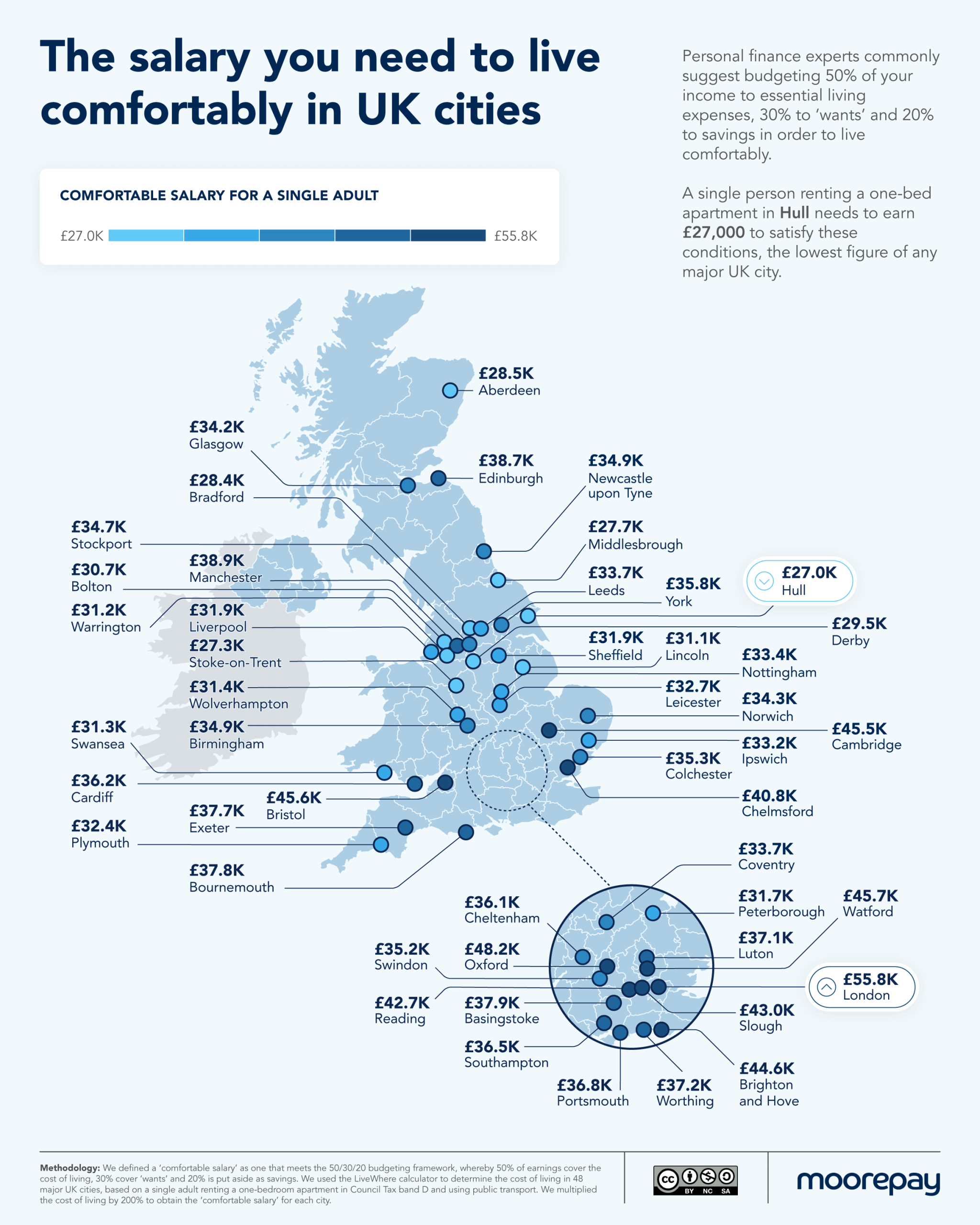
The Scottish city with the lowest salary needed to live comfortably is Aberdeen (£28,500), and in Wales it’s Swansea (£31,300).
The nine cities with the highest necessary earnings for a single person to live comfortably are all in the south, and all require a salary of over £40,000. London, the most expensive, has the only required salary of over £50,000 – to be precise, £55,800.

Chapter 3
The cities where the average salary exceeds what’s needed to live comfortably
In this chapter you’ll learn
- Locations where the average salary exceeds the local cost of living comfortably.
- Locations where the average salary doesn't meet the local cost of living comfortably.
Next, we compared the figures above with the actual average earnings in each city to see where the average worker earns more than the salary needed to live comfortably and where they fall short.
We found that the average salary exceeds the amount needed to live comfortably in 37 of the 48 cities in our study. The numbers work out best for savers in Aberdeen, where it takes a salary of £28,500 to cover a single person’s cost of living while leaving 30% for wants and 20% for savings. The average salary in Aberdeen is £43,700, creating a hypothetical excess of £15,200.
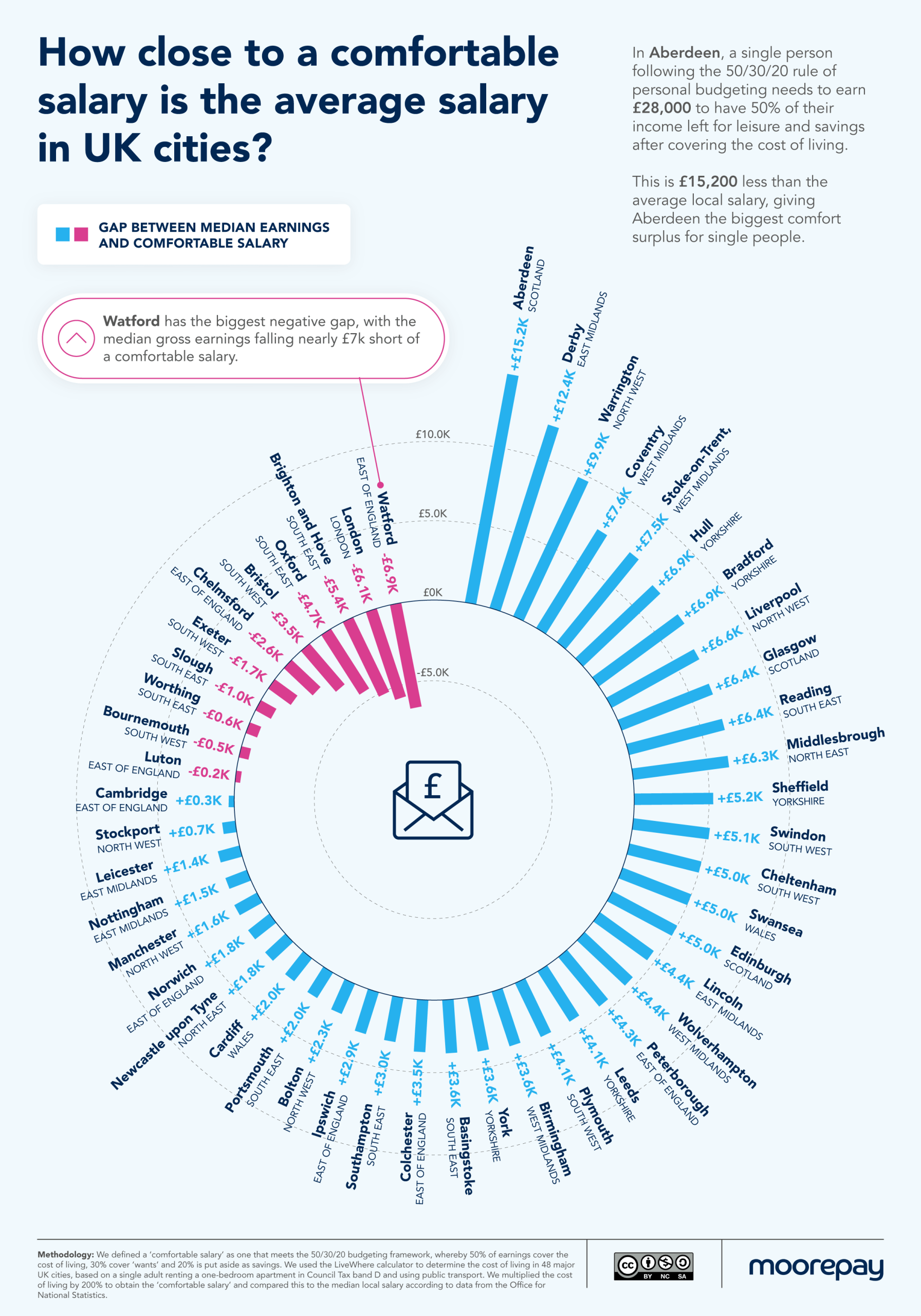
At the other end of the scale, locations where the average salary does not meet the local cost of living comfortably range from a shortfall of £156 in the large town of Luton to a deficit of over £6,000 in London and Watford.
It is Watford that has the biggest shortfall. With a comfortable salary threshold of £45,700 and average earnings of £38,700, the average single person in Watford falls £6,900 short of being able to budget by the 50/30/20 rule.
Read more about salaries and quality of life
-

Why poor wellbeing support is costing you your best employees
How businesses can look beyond simply offering a competitive salary in order to attract and reward the best talent.
-

The real value of minimum wages by country
See how the minimum wage around the world compares to local purchasing power in real terms.

Chapter 4
The household income a family of four needs to live comfortably
In this chapter you’ll learn
- The highest income requirements for a family of four to live comfortably.
- The lowest income requirements for a family of four to live comfortably.
Next, we adjusted our terms for our cost of living calculations to account for a family of four, owning a home in Council Tax band D on a 25-year mortgage and owning a car.
In London, a family in these conditions requires an income of £102,400 to afford to put 30% to ‘wants’ and 20% to savings after covering essential costs. This is the highest figure for any part of the UK; the closest runner-up is Cambridge, where such a family needs £93,000 to save like this.
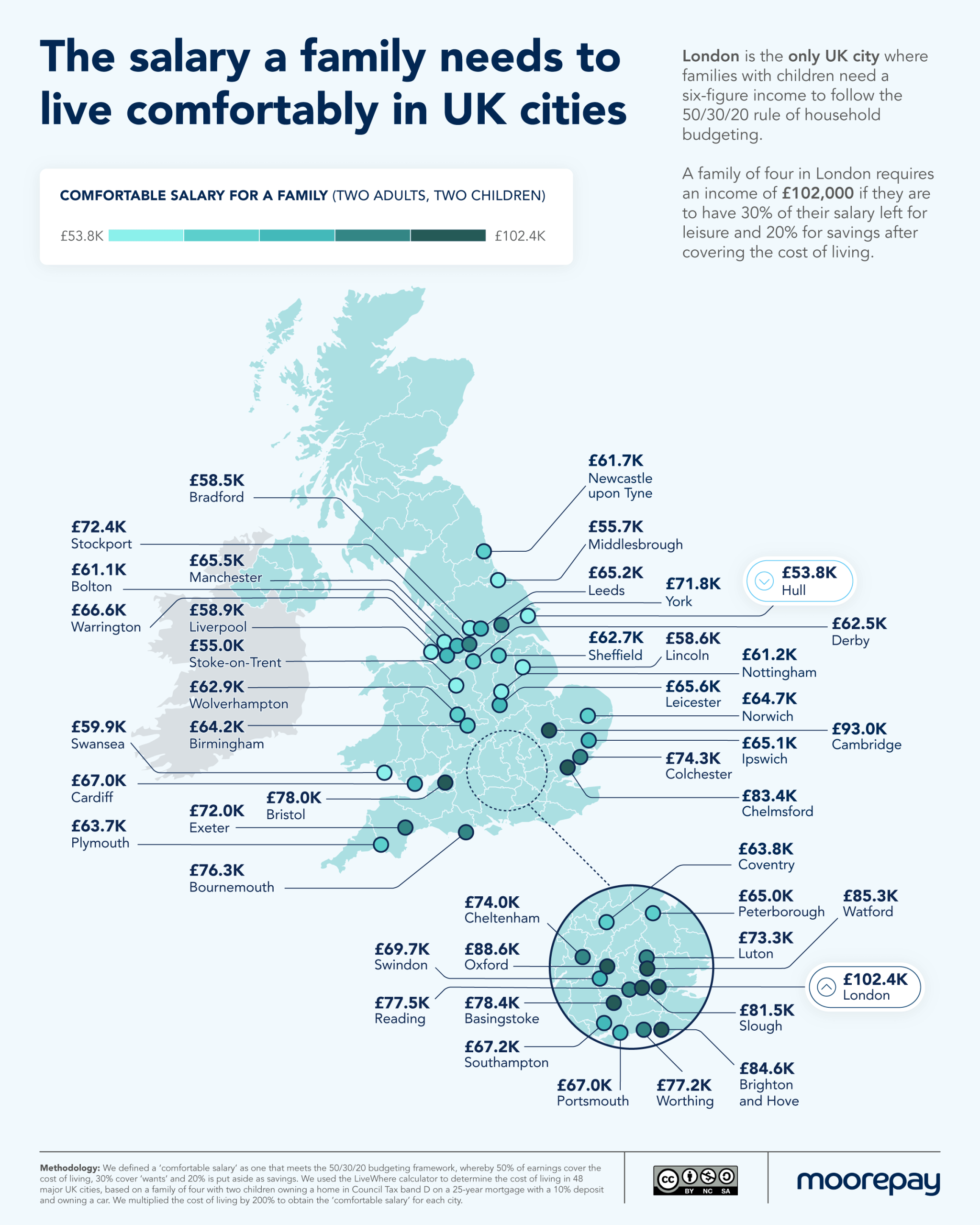
Again, Hull is the city with the lowest income requirements to live comfortably. A household income of £53,800 should cover it for a family of four. The cities with the lowest income requirement for comfortable family living are all in the Midlands and the North of England, except for Swansea in Wales, where the salary needed to live comfortably is £59,900.

Chapter 5
How the salary needed to live comfortably varies between London boroughs
In this chapter you’ll learn
- The highest and lowest gaps between median earnings and a comfortable salary across London boroughs.
London has the UK’s highest cost of living, and the income required to live comfortably far exceeds the average local salary. But conditions vary widely between (and within) the city’s 32 boroughs.
We found that the boroughs of Kensington and Chelsea (£78,000) and Westminster (£74,900) have the highest salary requirements to meet the 50/30/20 budgeting rule. This is up to 67.8% more than the borough with the lowest such requirement, Hillingdon (£46,500).
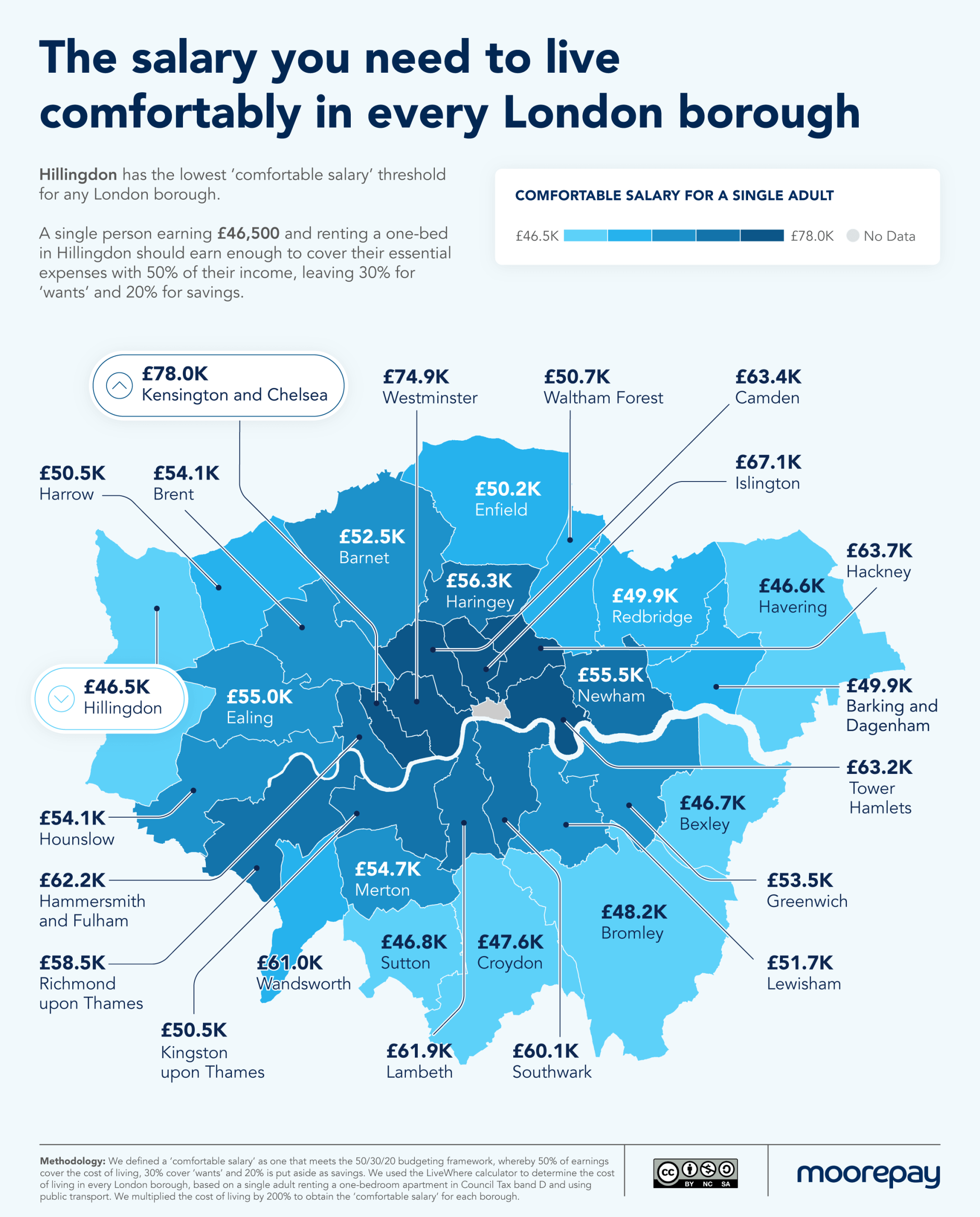
The boroughs of Westminster and Kensington and Chelsea also have the highest gap between median earnings and a comfortable salary (below) – a vast £32,400 shortfall in the case of Kensington and Chelsea.
Wandsworth, Richmond upon Thames and Merton are among the five boroughs with the biggest negative disparity between median earnings and the amount required to live comfortably. They are also among the five boroughs with the highest wage inequality, suggesting an even steeper challenge for many residents to meet the 50/30/20 requirements.
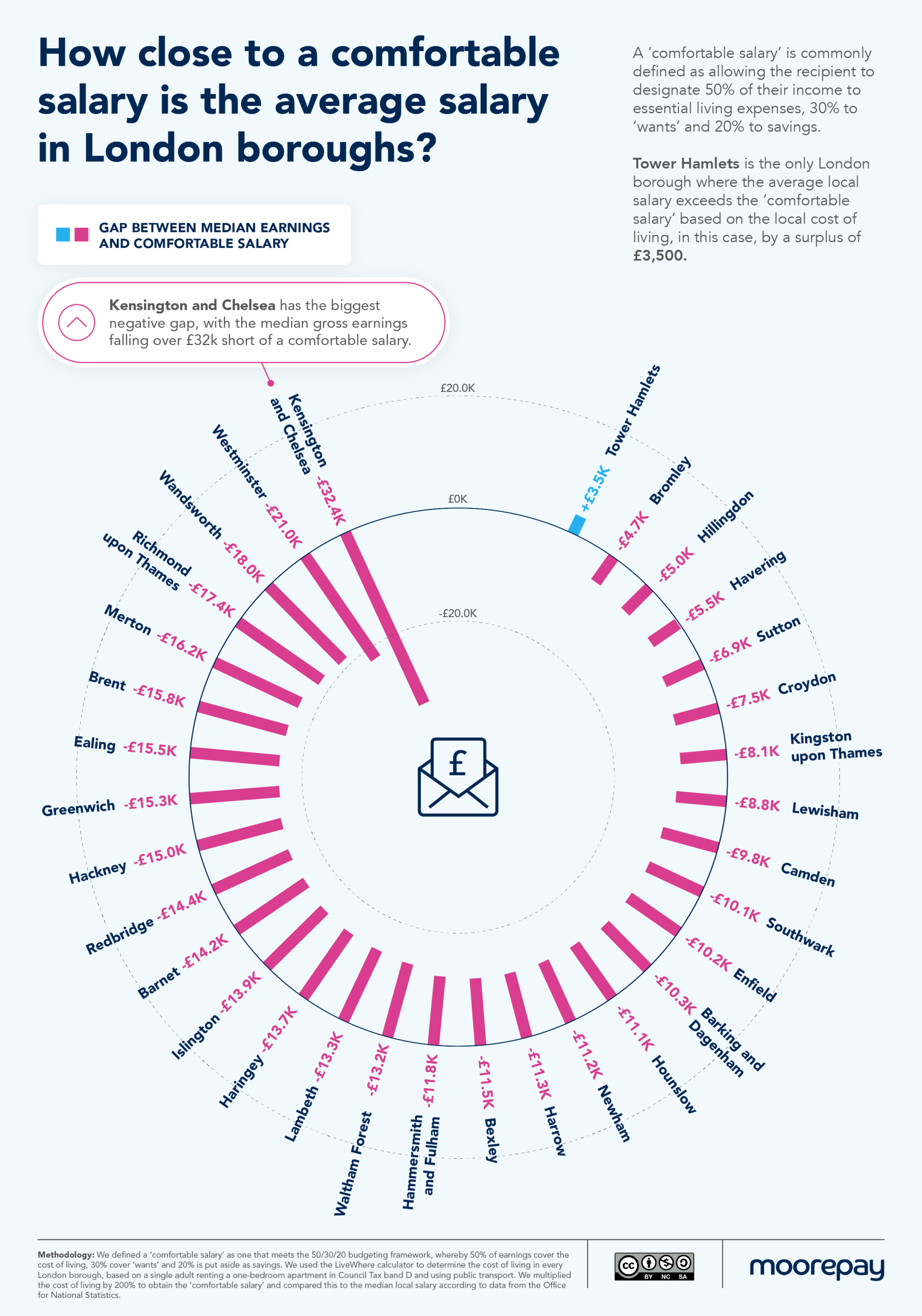
The only London borough where the average income exceeds the salary needed to live comfortably is Tower Hamlets, where the comfortable income sits at £63,200 — leaving a hypothetical surplus of £3,500.
Hillingdon is the borough with the lowest income for comfortable living, at £46,500. However, this is still £5,000 higher than the average salary within the borough.

Chapter 6
Examine the data on the gap between the ‘comfortable’ salary and local average incomes
In this chapter you’ll learn
- The full data comparing salary needed to live comfortably in UK cities and London boroughs against average local income.
Finally, here is the full data comparing the salary needed to live comfortably in UK cities and London boroughs against the average local income in each case.
Use the tabs and search function to sort the data and find the places where locals are most likely to afford living by the 50/30/20 household budgeting rule.
PAST WEBINAR
Retention strategies | Keeping your best people
Struggling to keep top talent? Discover how to build a loyal, motivated workforce with our free HR Masterclass on retention strategies that actually work.
You’ll gain practical insights into the Three Rs of Retention and learn proven strategies to strengthen employee loyalty and engagement.

Chapter 7
Frequently asked questions
In this chapter you’ll learn
- Frequently asked questions about unfair dismissal protection.
- Methodology and sources of this report.
FAQs
The 50/30/20 budgeting strategy is a guideline on how to save money while living comfortably – provided your income is high enough to abide by it. To use the system, allocate 50% of your income to essential needs such as housing, bills and groceries; 30% to non-essential ‘wants’; and the remaining 20% to savings.
In Hull, a single person renting a one-bedroom apartment in Council Tax band D and using public transport requires a salary of £27,000 to cover essential expenses with half their income. This is the lowest figure of any major UK city.
In London, a family of four owning a home in Council Tax band D on a 25-year mortgage with a 10% deposit and owning a car would need a combined income of £102,400 to meet the requirements of the 50/30/20 rule
The borough of Hillingdon has the lowest required income (£46,500) to afford the 50/30/20 rule. However, Tower Hamlets is the only borough where the average income exceeds the salary needed to live comfortably – in this case, by a surplus of £3,500.
Hull has the lowest salary needed for a single person to live comfortably, at just £27,000.
However it is Aberdeen which has the highest ‘surplus’ i.e. the biggest gap between a comfortable salary (£28,500) and the average local salary (£43,700). Leaving 30% for wants and 20% for savings, this leaves a hypothetical excess of £15,200.
By considering the local cost of living, recruiters can set more appropriate and fair salary levels to attract the best talent. Addressing the cost of living in your wage structure can also make employees feel supported and reduce the temptation to supplement their work with side hustles and gig work.
Methodology & Sources
We defined a ‘comfortable salary’ as one that meets the classic 50/30/20 budgeting framework, whereby 50% of earnings cover the cost of living, 30% cover ‘wants’ and 20% is put aside as savings.
We used the LiveWhere calculator to determine the cost of living for 48 major UK cities and every London borough, based on the following parameters for a single adult and family:
Single Adult
– Renting a one-bedroom apartment
– Travelling by public transport
– Council Tax band = D
Family
– Two parents
– Two children
– 25-year mortgage with a 10% deposit
– Owns a car
– Council Tax band = D
Since we defined a comfortable salary as one where 50% covers the cost of living, we multiplied these cost of living values by two to determine the required salary. Finally, we compared the median gross earnings by location (using ONS data) to each area’s ‘comfortable salary’ to identify the areas where the average salary falls short of or exceeds this figure.
Data is correct as of October 2026.
Contents
-
Chapter 1
Introduction
-
Chapter 2
How much does a single person need to live comfortably in UK cities?
-
Chapter 3
The cities where the average salary exceeds what’s needed to live comfortably
-
Chapter 4
The household income a family of four needs to live comfortably
-
Chapter 5
How the salary needed to live comfortably varies between London boroughs
-
Chapter 6
Examine the data on the gap between the ‘comfortable’ salary and local average incomes
-
Chapter 7
Frequently asked questions