GLOBAL PAID LEAVE REPORT
The global paternity leave report 2026
Paternity leave gives fathers valuable time to bond with their child and support their family during the early days and months of parenthood. But which countries offer the most leave and the best pay rates? We examined paternity leave policies across the globe to find out.

Contents
-
Chapter 1
Introduction
-
Chapter 2
The most valuable statutory paid paternity leave in the world
-
Chapter 3
How paid paternity leave adds up compared to weeks at full pay, globally
-
Chapter 4
How UK paternity leave stacks up against the rest of Europe
-
Chapter 5
Explore the full data on paternity leave around the world
-
Chapter 6
Frequently asked questions
Key findings
-
4010UK’s paternity pay – The value of statutory paid paternity leave for a father on the average salary.
-
17803World’s highest paternity pay – The average value of paid paternity leave in South Korea.
-
7.6Weeks off at full pay when the average UK father takes their two weeks of statutory paternity leave and splits 50% of available shared leave with their partner.

Chapter 1
Introduction
In this chapter you’ll learn
- How paternity leave benefits a father and their family.
- The link between paternity leave and mental health.
- How we collected data and compared paid paternity leave around the world.
A father’s presence and contribution in the early months of a baby’s life are immeasurably valuable to the baby, mother, father and family unit.
For fathers in particular, those who can take a longer period of leave may develop skills and an emotional bond during paternity leave, that can flourish throughout their baby’s childhood. They also often experience improved well-being during a period when many fathers feel the strain.
Bottom line, mental health and paternity leave are linked,”
says Dr Craig Garfield, co-author of a paper on paternity leave status and mental health symptoms.
Our findings underscore that paternal leave is not just a workplace benefit, it’s a public health issue that can deeply impact families and children.”
To see how paternity leave for fathers in the UK measures up with other countries, Moorepay first created a model paternity situation (firstborn child, only child, two working parents) to compare like-for-like. We then used government and other reliable sources from each country to determine what kind of statutory paid parental leave this model father would be eligible for.
Although for the sake of the data we have named “fathers” and “mothers” in this report, we know families are more diverse than this. People eligible for paternity leave include fathers, the husband/partner of the mother/adopter (including same-sex partners), the child’s adopter, and the intended parent through surrogacy. Eligibility in the UK does not depend on the gender of the parent, and so nonbinary and women can take it, depending on their relationship with the birthing parent.

Chapter 2
The most valuable statutory paid paternity leave in the world
In this chapter you’ll learn
- How we calculated the value of paternity leave in each country.
- The country with the highest value paternity leave.
- How UK paternity pay measures up internationally.
First, we examined how statutory paternity leave adds up in terms of monetary value around the world. To do this, we calculated the cash value of paternity leave and converted it to British pounds for comparison. We also converted these figures into international dollars, a hypothetical currency that uses local purchasing power to provide a more realistic impression of what a sum is worth locally.
We found that South Korea has the most valuable paternity leave both in absolute terms and when adjusted for local purchasing power.
With up to 18 months of leave at a variable rate, the average South Korean father in our model scenario stands to earn just over 36 million South Korean Won (KRW), or £17,803 (GBP). This is just a few hundred pounds more than Luxembourg and Sweden, but nearly three and a half times what the average UK father might claim (£4,010).
When factoring in purchasing power, the gap is wider: paternity leave in South Korea is worth Intl$42,797, 55.6% more than second-placed Japan (Intl$27,518) and 7.5 times as much as the UK (Intl$5,739).

Chapter 3
How paid paternity leave adds up compared to weeks at full pay, globally
In this chapter you’ll learn
- How we found a fairer way to measure the value of paternity leave.
- How paid paternity leave compares to regular pay in Australia.
- How many countries offer no statutory paid paternity leave.
Many countries offer statutory paternity leave on a reduced or decreasing scale of pay. To give a clearer idea of what this actually means for a new parent’s household budget, we calculated the average amount of pay a father in our model situation could claim in each country and the number of weeks at full pay (national average) to which this figure is equivalent.
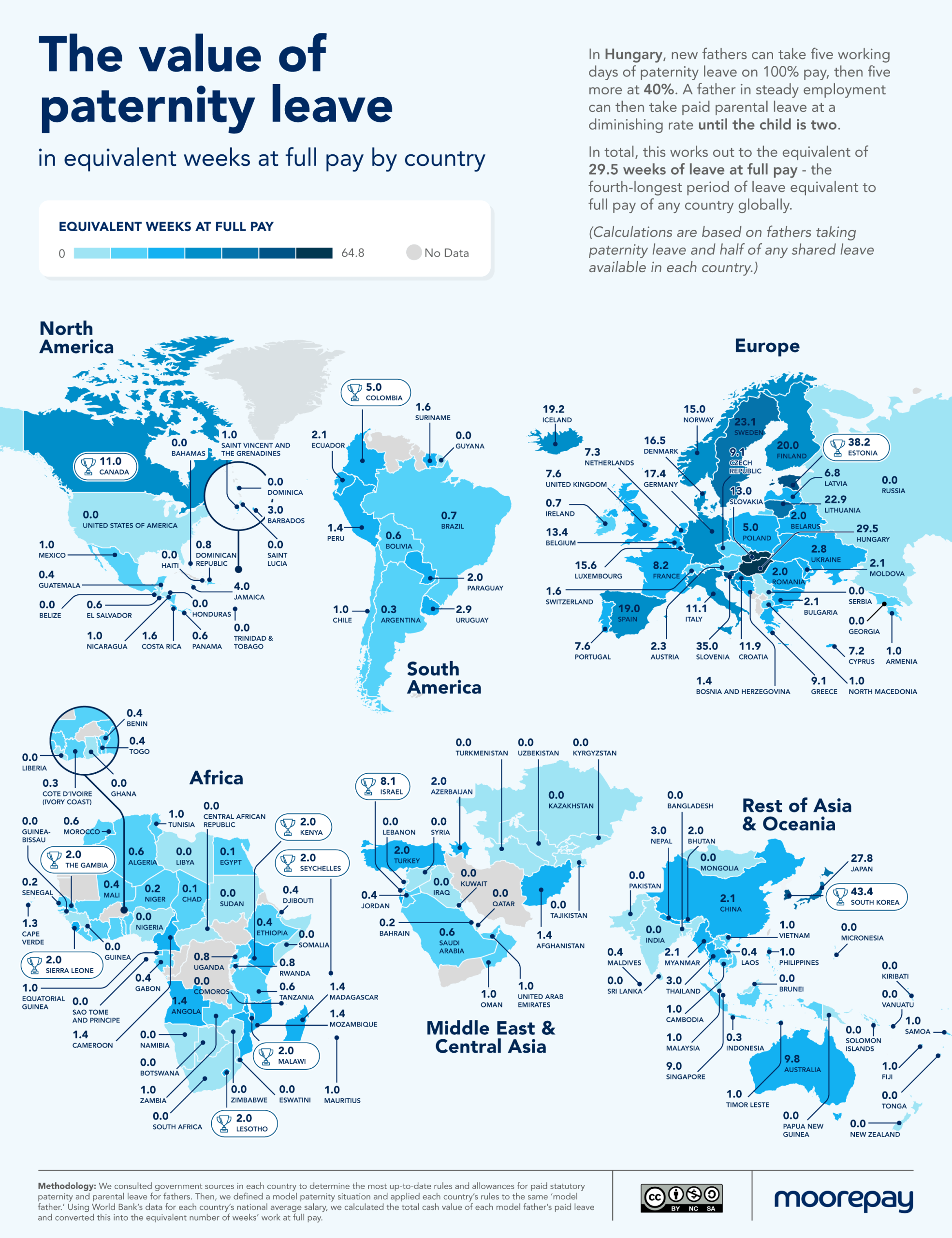
For example, since July 2026, Australian families have been eligible to share up to 26 weeks of leave on $948.10 per week. Assuming that this leave is shared equally between two partners, our model father would earn AUS$12,325.30. This is equivalent to 9.8 weeks of work at the full national average pay. The country with the highest number of weeks of equivalent full-time pay is South Korea (43.4 weeks).
There are 51 countries in our study that offer no statutory paid paternity leave at all to a father in our model situation, including the U.S., Serbia and New Zealand. In New Zealand, partners do not get paid leave, although the father could take leave instead of the mother if he were to become the “primary carer.”

Chapter 4
How UK paternity leave stacks up against the rest of Europe
In this chapter you’ll learn
- Which European countries offer the best paternity pay compared to regular pay.
- How paid paternity leave is calculated in Sweden.
- How much paternity leave UK fathers are eligible for and how much it’s worth.
Our next chart compares the equivalent number of weeks at full average pay that paid paternity leave is worth around Europe.
Sweden has Western Europe’s best offer in this regard. Swedish parents can share up to 480 days of leave (up to 96 days of which can be saved for use when the child is a bit older), with the first 390 days paid as a proportion of the parent’s wage and the remainder at a flat rate of SEK 180 (£14) per day. For a father on the average Swedish salary, this adds up to SEK 221,603 (£17,518), the equivalent of 23.1 weeks at full pay.
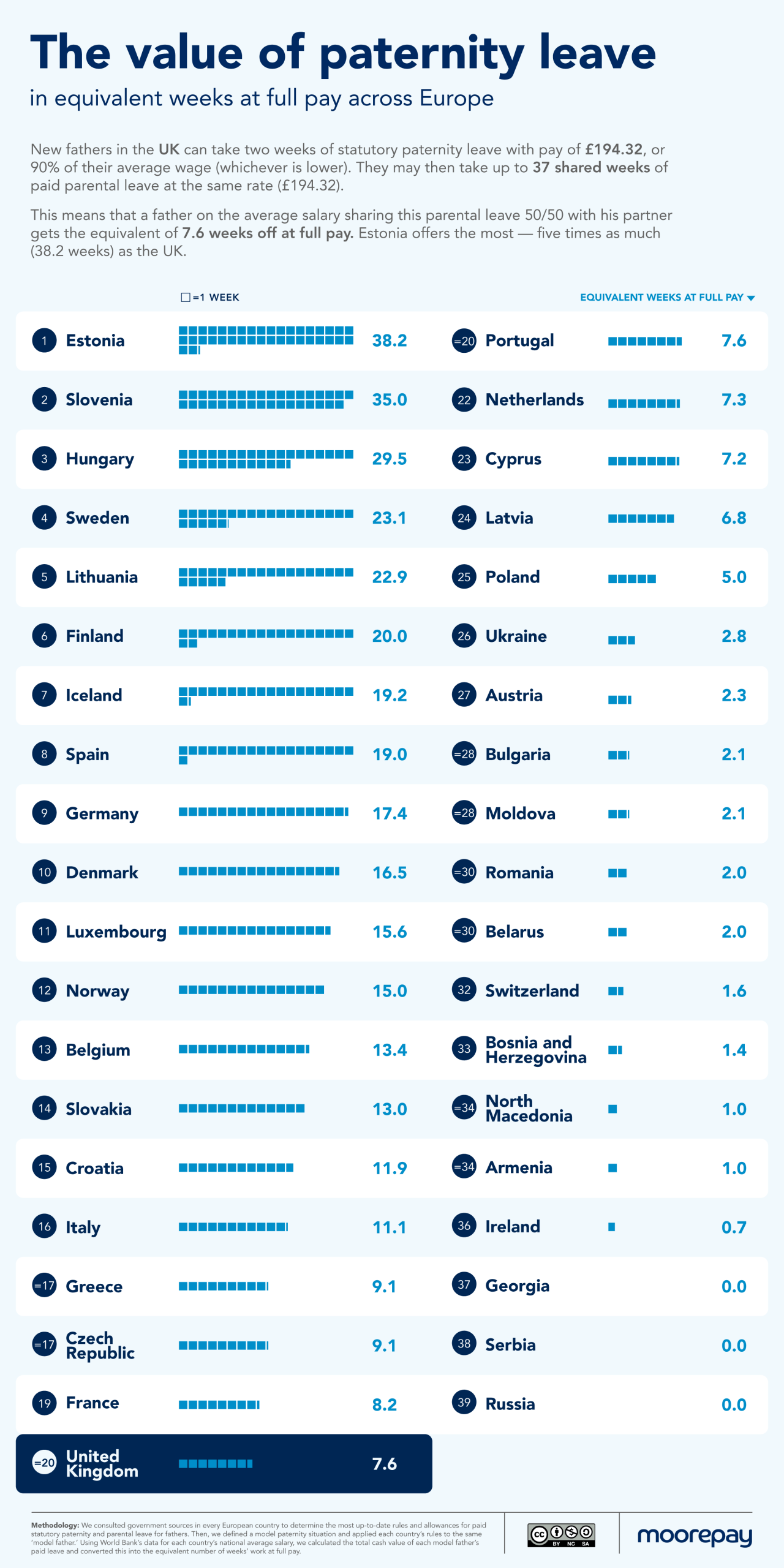
Fathers in the UK may be eligible for two weeks of statutory paternity leave when expecting or adopting a child or having a baby through surrogacy, at a pay rate of £194.32 per week, or 90% of the father’s average weekly earnings (whichever is lower).
They may also share up to 50 weeks of leave, up to 37 weeks of which are paid, with their partner. The average UK father who takes his two weeks’ leave and shares the rest earns £4,010 on paternity leave, the equivalent of 7.6 weeks of full pay.
Read more about paternity pay
-

Your guide to paternity leave and pay
When your employee tells you their family is expecting a baby, there’s a lot to do. We’ve compiled everything you need to know in one in-depth resource.
-

Statutory parental pay rates
The up-to-date statutory payments to assist eligible employees during paternity leave.

Chapter 5
Explore the full data on paternity leave around the world
In this chapter you’ll learn
- How much paid paternity leave is worth in pounds sterling, American dollars, and the international dollar.
- How many weeks of paid paternity leave for which fathers are eligible in each country.
Finally, we compiled all our data into this interactive table so you can explore the state of statutory paid paternity leave worldwide.
Switch tabs, use the search function and sort the data to see how much paid paternity leave is worth in pounds sterling, American dollars, and the international dollar (which adjusts figures to account for local purchasing power, giving a truer reflection of a sum’s value). You can also see how many weeks of paid paternity leave for which fathers are eligible in each country, versus the equivalent number of weeks off at full pay when taking into account shared leave and variable rates of pay.
PAST WEBINAR
ERA Readiness Series: getting to grips with day one rights
The Employment Rights Act 2025 (ERA) brings some of the biggest changes to employment law we’ve seen in decades. And as part of this, from 6 April 2026, paternity leave in the UK became a day one employment right. The 26‑week qualifying period was removed, aligning it more closely with maternity and adoption leave.
Watch this webinar to understand the positives, the challenges and what this really means in practice.


Chapter 6
Frequently asked questions
In this chapter you’ll learn
- Frequently asked questions about paternity leave across the world.
- Methodology and sources of this report.
FAQs
South Korea offers up to 18 months of leave on a variable rate. The average South Korean father may earn just over 36 million South Korean Won (KRW) – equivalent to £17,803 (GBP) or Intl$42,797.
Moorepay identified 51 countries that offer no statutory paid paternity leave, including the U.S., India and New Zealand. See the table in Chapter 5, above, for the full list of countries.
South Korea (82.0 weeks) and Japan (48.0) offer the most paid parental leave for fathers.
In the UK, fathers may be eligible for two weeks of statutory paternity leave at a pay rate of £194.32 per week, or 90% of the father’s average weekly earnings (whichever is lower). They may also share up to 50 weeks of leave, of which up to 37 weeks are paid, with their partner.
Methodology
We consulted governmental and other reliable sources in the official language of every country in the world to determine the most up-to-date rules and allowances regarding paid statutory paternity leave and parental leave for fathers.
First, due to the different clauses and assumptions reflected in each country’s laws, we defined a model paternity situation: firstborn child, only child, two working parents, no labour complications nor health issues. Parents work in the private sector, and in case of a shared parental leave option, they decide to split it 50/50. If the mother can’t choose the amount of leave to transfer to the father, we don’t consider it shared parental leave. A 5-day working week, unless stated otherwise in paternity laws.
With these parameters defined, we researched each country’s policies to determine the length and total pay for which this model father would be eligible.
To help put figures into context, we also obtained the latest available net national income per capita by country from the World Bank and used it as a proxy for average yearly earnings. We then divided this figure into weekly earnings, and converted it into each country’s local currency unit (LCU). We used Purchasing Power Parity (PPP) to convert the average pay in each country into International Dollars (INTL$), a hypothetical currency which “would buy in the cited country a comparable amount of goods and services a U.S. dollar would buy in the United States.” We also converted the figures to GBP and USD for comparison purposes.
These monthly earnings figures were used to calculate the paternity benefits earned by the ‘hypothetical father’ in each country and the number of full pay weeks to which the paternity benefits are equivalent.
Data is correct as of July 2026
Contents
-
Chapter 1
Introduction
-
Chapter 2
The most valuable statutory paid paternity leave in the world
-
Chapter 3
How paid paternity leave adds up compared to weeks at full pay, globally
-
Chapter 4
How UK paternity leave stacks up against the rest of Europe
-
Chapter 5
Explore the full data on paternity leave around the world
-
Chapter 6
Frequently asked questions