Introducing our new People Analytics reporting experience

A clearer way to understand your payroll and workforce data
Payroll and people data have become increasingly important for UK organisations.
According to the Office for National Statistics, the UK labour market continues to change. Shifts in employment patterns, participation, and job mobility place greater demands on how organisations understand and manage their workforce.1
Payroll reporting sits at the centre of this challenge. UK government guidance and workforce reporting standards increasingly expect organisations to maintain accurate, well‑governed payroll and workforce data that can support both operational needs and strategic scrutiny. 2
Against this backdrop, organisations need more than static reports. They need clear, trusted reporting that brings payroll, people, and cost data together in a way that supports confident, joined‑up decisions.
That’s why we’ve introduced a new People Analytics reporting experience within Moorepay Payroll.
This isn’t just new screens or refreshed visuals. It’s a rethought reporting experience, designed to bring payroll and people data together in one clear, trusted view. It helps you understand what’s happening, see how things are changing, and make confident decisions, without needing specialist reporting skills.
Everything is powered directly by your payroll data and designed to fit naturally into how HR, payroll, and finance teams work.
Reporting built around real questions
People Analytics is designed around the questions teams ask every day.
For example:
- What does our workforce look like today?
- How is headcount changing over time?
- Where are payroll and absence costs rising?
- Are we growing, shrinking, or staying stable?
- What’s happening with hiring and retention?
Instead of disconnected reports, the experience is structured to guide you from headline answers to deeper insight. This means less time interpreting data and more time understanding what it means for your business.

A clear view of your workforce, as it is today
People Analytics gives you up‑to‑date visibility of your workforce.
You can see:
- Current headcount.
- Workforce composition, including full‑time, part‑time, and other worker types.
- Breakdown by department.
- Visibility by gender and ethnicity.
This gives HR, payroll, and finance teams a shared, accurate picture of the workforce, so everyone is working from the same understanding when questions come up.
Insight that shows how things are changing
Understanding your people isn’t just about totals. It’s about understanding movement and direction.
That’s why People Analytics is built with clear trends throughout the experience. Across workforce, payroll, absence, and diversity, you can see how things are changing over time, not just where they landed.
You’ll find:
- Rolling views that show change month by month.
- Clear indicators of growth, decline, and stability.
- Visibility into how different teams and groups are evolving.
These turn reporting into insight, helping teams spot patterns early and act with confidence.
A simpler structure that makes reporting easier to use
The reporting experience is organised into clear, focused areas, designed to reflect how people naturally explore data.
Reporting is grouped into areas such as:
- Workforce and headcount.
- Diversity and workforce composition.
- Absence and wellbeing.
- Payroll and compensation.
- Starters and leavers.
Each area follows the same clear structure: headline information first, trends next, then detail when you need it. This consistency makes reporting easier to navigate and easier to explain to others.
Clearer insight into absence and wellbeing
Absence data often needs context to be useful. People Analytics brings structure and depth so you can understand patterns, impact, and cost together.
You can explore:
- Sickness absence trends.
- Bradford Score insight.
- Other absence types, including statutory absence.
- Absence by department.
Payroll reporting with the context behind the numbers
Payroll figures often prompt follow‑up questions. People want to understand why costs are changing, not just what the totals are.
People Analytics helps by showing payroll data in context, including:
- Month‑by‑month views of gross pay, deductions, tax
,and National Insurance. - Visibility into employer costs over time.
- Clear insight into overtime and bonus payments.
- Department and employee‑level views where they add clarity.
With consistent timeframes and built‑in history, it’s easier for payroll and finance teams to explain change and support planning.
A clearer picture of hiring, retention, and turnover
People Analytics brings hiring and turnover reporting into one joined‑up experience.
You can see:
- Starter and leaver trends over the last 12 months.
- Breakdown by department and age range.
- How starters and leavers compare over time.
This gives leaders a quick, reliable way to understand whether the organisation is growing, where retention may be under pressure, and how hiring patterns are shifting.
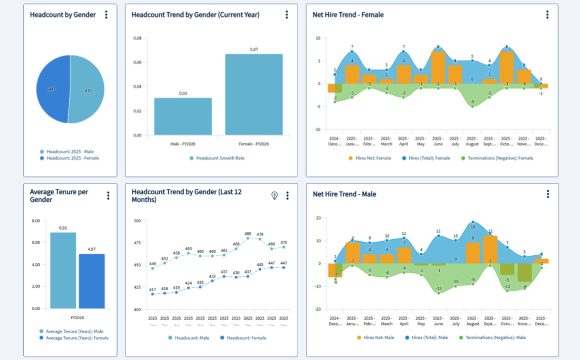
Practical insight into workforce diversity
Diversity and workforce balance are important areas of focus for many organisations. People Analytics provides clear, practical reporting to support these conversations.
You can view:
- Workforce composition by gender and ethnicity.
- How that composition changes over time.
- Department‑level breakdowns.
- Pay ratios and average salary views by gender.
Because this insight is drawn directly from payroll and structured consistently, teams can have evidence‑based discussions with confidence.
Reporting everyone can trust
A core principle behind the new People Analytics experience is trust.
Reporting is designed to:
- Align data to the right fiscal, tax, or rolling periods.
- Apply consistent definitions across views.
- Present information in a clear, logical hierarchy.
This reduces confusion, limits reconciliation work, and helps HR, payroll, and finance teams stay aligned around the same numbers.
Designed for everyday use
People Analytics is built for the people who use it day to day.
Whether you work in payroll, HR, or finance, the experience is designed to be:
- Easy to navigate.
- Easy to understand.
- Easy to use in conversations with stakeholders.
You don’t need to build reports or manipulate data externally. The insight is already there, structured to answer common questions clearly.
Reporting that adapts to how your organisation works
Different teams need to explore insight in different ways. People Analytics gives you the flexibility to shape reporting around what matters most to your organisation.
You can:
- Create personal dashboards using existing dimensions and metrics.
- Define custom dimensions that reflect how you structure your workforce.
- Create custom metrics aligned to your own measures of success.
- Connect reporting to external business intelligence tools.
- Configure user permissions to control access and visibility.
This flexibility helps teams focus on the insight that’s most relevant to them, while still working from a shared, consistent reporting experience.
Reporting that adapts to how your organisation works
Clear reporting matters because it shapes better decisions.
The new People Analytics reporting experience is designed to help you see what’s happening across your people and payroll, understand how things are changing, and act with confidence. It brings together workforce, cost, and payroll insight in one structured, trusted view, so teams spend less time interpreting data and more time using it.
To find out more about People Analytics in Moorepay Payroll, speak to your Moorepay contact or explore how the new reporting experience can support your organisation by requesting a demo.
Sources:
- Office for National Statistics (ONS) – UK labour market overview and employment trends
https://www.ons.gov.uk/employmentandlabourmarket ↩︎ - GOV.UK – Workforce reporting, payroll governance, and public‑sector employment data
https://www.gov.uk/government/publications/workforce-management-information-2025 ↩︎